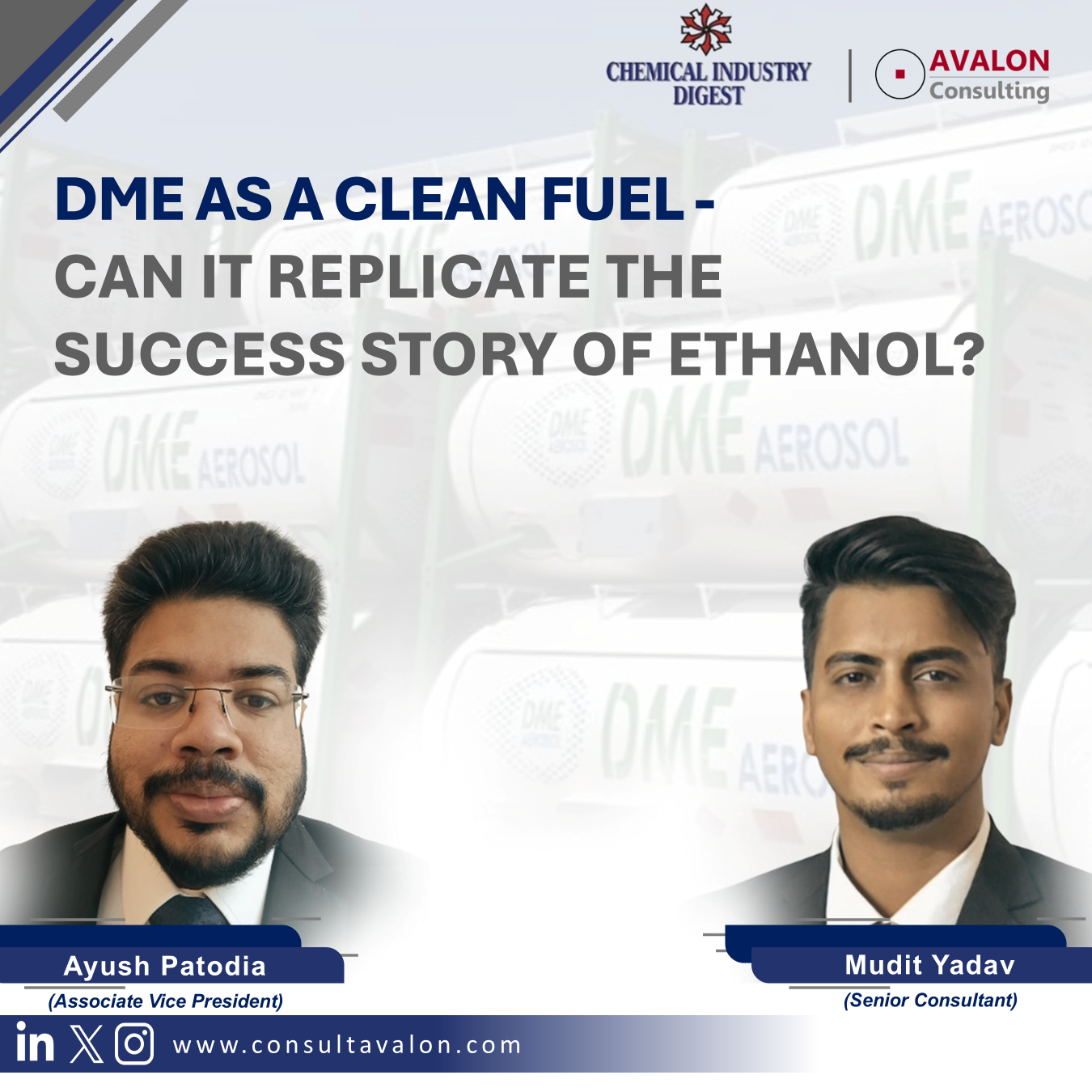
Ayush Patodia, Associate Vice President and Mudit Yadav, Senior Consultant at Avalon Consulting shared their views on the role of Dimethyl Ether (DME) in India’s clean fuel transition in the article “DME as a Clean Fuel – Can it Replicate the Success Story of Ethanol?”
They highlighted that India’s growing dependence on imported crude oil and LPG underscores the need for alternative fuels, and positioned DME as a promising solution for diesel and LPG applications where ethanol has limited suitability. The article notes that DME can help reduce import dependence, leverage existing LPG infrastructure, and support India’s broader energy security goals.
India’s crude oil and LPG import profile highlights its external dependencies
The situation unfolding in central Asia has laid bare India’s structural exposure to imported diesel and LPG. The Ministry of Petroleum and Natural Gas was forced to limit average monthly commercial LPG supply, and slash allocations to commercial users.
| Metric | FY21 | FY22 | FY23 | FY24 | FY25 | YTD-Jan, FY26 |
| Crude oil imports (MMT) | 196.5 | 212.2 | 232.4 | 232.5 | 244.5 | 203 |
| Crude oil import bill (USD bn) | 62.2 | 119.2 | 157.5 | 132.4 | 137 | 106 |
| Crude import dependency (%) | 84.4% | 85.5% | 87.4% | 87.8% | 88.2% | 88.6% |
| LPG consumption (MMT) | 27.6 | 28.3 | 28.5 | 29.6 | 31.3 | 27.4 |
| Domestic LPG production (MMT) | 12.3 | 12.3 | 12.6 | 12.6 | 12.8 | 10.6 |
| LPG imports (MMT) | 15.3 | 16.0 | 15.9 | 17.0 | 18.5 | 16.8 |
| LPG import dependency (%) | 55% | 57% | 56% | 58% | 60% | 61% |
In FY25, India used 239.5 million metric tons of petroleum products, which is 2.2% more than the year before. That basket had 38.5% diesel, 16.7% petrol, and 13.1% LPG. Transport uses about 70% of all the diesel in the country, agriculture uses about 13%, and manufacturing uses about 9%. The household cylinder market makes up the majority of LPG demand, while commerce and industry users make up a smaller tail.
Ethanol has limitations when blending with diesel and LPG, which DME addresses
India already has a proven and scalable template in clean-fuel transition through the Ethanol Blended Petrol (EBP) programme. The next logical step is to build a similar pathway for the much larger diesel, LPG, and industrial fuel oil pool, which together are more than three times the size of the petrol opportunity. This is where Dimethyl Ether (DME) is increasingly emerging as a credible candidate. Ethanol has limited relevance in this context, as it is not well suited for blending into diesel or LPG. Its low cetane number restricts diesel use, its hygroscopic nature creates blending and handling challenges, and it cannot be liquefied alongside propane and butane for use in LPG cylinders.
DME, by contrast, has a far stronger functional fit. It is a colourless, non-toxic, and non-corrosive gas that liquefies under relatively low pressure, similar to LPG. While its calorific value is around 70% of diesel on a mass basis, it offers a higher cetane number than diesel, making it technically attractive for combustion applications. It also shares important physical handling characteristics with LPG components such as propane and butane. That said, DME is chemically distinct from methane and therefore does not have a natural role in PNG or CNG blending.
Importantly, the technical groundwork is already being laid. The World LPG Association’s technical working group, following extensive safety and materials testing, has concluded that LPG can accommodate DME blending of around 12% by mass without requiring modifications to existing storage, transport, or end-use equipment. In India, the Bureau of Indian Standards has gone further by permitting up to 20% DME blending in LPG for domestic, commercial, and industrial applications, with blends of around 8% requiring no changes to cylinders, regulators, or burners. On the diesel side, research led by Ford’s consortium indicates that 80:20 diesel-DME blends can meet material compatibility requirements with only minor retrofits to existing vehicles.
Building a grey DME ecosystem will be crucial to scaling green DME in the future, once prices become competitive
DME can be produced in two main ways,
- One-step direct DME synthesis: A single reactor turns syngas, which comes from coal gasification, natural gas, or biomass, into DME. This route is usually better for big, integrated plants where getting feedstock and turning it into something else are closely linked.
- Indirect DME synthesis (two steps): First, methanol is made from syngas, green hydrogen, or biomass. Then, it is dried to make DME. This is the most common way to get DME around the world. It makes up more than 90% of all DME capacity, including most plants in China. This is because it can use existing merchant methanol supply chains and keeps the DME plant separate from the decision about where to get the feedstock.
From an economics standpoint, DME’s viability depends heavily on the feedstock and production route. Conventional DME can be competitive with LPG-linked alternatives, particularly when it is produced from merchant methanol. Green DME, on the other hand, is still much more expensive today because its economics are linked to green methanol and green hydrogen, both of which are still much more expensive than traditional methods. CSIR-NCL has also said that the price of methanol has a big effect on the cost of DME production. They think that DME costs about 1.8 times as much as methanol, which means that if methanol prices go down, DME could get very close to LPG parity and maybe even below it over time.
For India, this opens up two practical strategic routes. One is a coal-linked methanol/DME pathway, aligned with NITI Aayog’s Methanol Economy agenda and supported by India’s large coal resource base, including high-ash coal that has limited alternate application. The second is methanol-to-DME, which is made from imported methanol. NITI Aayog reports say that this type of methanol already makes up most of India’s methanol supply because imports have historically been cheaper than production based on natural gas. This is important from a strategic point of view because India still gets about 60% of its LPG from other countries, and about 90% of those LPG imports go through the Strait of Hormuz.
India can learn from Europe, China, South Korea, and the US when it comes to making a DME program that will last and grow
China makes about 82% of the world’s DME, or about 8.2 MMT in 2023, mostly from coal-based methanol. Outside China, momentum is building around renewable and low-carbon DME. In Korea, Biofriends is scaling renewable DME using captured CO₂ and has partnered with Cheongmyeong to develop the country’s first biogas-to-methanol-to-DME facility, while another consortium has started piloting 12% bio-DME blended LPG in the domestic market. In Europe and the US, the model is increasingly offtake-led: Oberon Fuels and SHV Energy have partnered to scale renewable DME, while Superior Plus has signed a 10-year offtake agreement with InEnTec.
The bigger tech ecosystem is already in place and is now moving toward being able to sell things. Haldor Topsoe and Air Products are working on big projects that use DME, ammonia, and methanol. Enerkem has made progress on ways to turn waste into methanol. Oberon Fuels, NextChem, MyRechemical, and Dimeta are all working on modular and waste-to-DME solutions. The CSIR-NCL in India has made its own methanol-to-DME catalyst and a flex-fuel burner that can use any kind of fuel, from 100% LPG to 100% DME. This shows that the country’s technology base is beginning to take shape.
The government should focus on building the foundational elements that made the EBP a success to kick off the DME economy
The policy direction is encouraging, but the execution architecture for DME is still incomplete. The Methanol Economy program from NITI Aayog, which mixes 20% DME into LPG, says it will save ₹6,000 crore a year. India also wants to replace 10% of its crude oil imports with methanol and its derivatives by 2030. This means that India needs about 30 MMT of methanol capacity. The MoRTH has already set standards for M15, M85, and M100 methanol fuel for transportation. DME hasn’t gotten the same policy push yet, though. There is still no recognition of flex-fuel or a mandatory blending target for DME. This creates a gap between strategic intent and market activation.
The commercial enablers are also missing. There is currently no VGF or PLI mechanism to bridge the cost gap between grey and green DME, indicating the need for a support structure similar to the SIGHT scheme under the National Green Hydrogen Mission. Feedstock aggregation is another structural gap. Ethanol scaled because India had relatively organised sugarcane and grain supply chains; sustainable DME would require a comparable system for biomass and municipal solid waste, which does not yet exist. On the demand side, there is still no assured offtake pricing or procurement commitment from oil marketing companies. For bio-DME projects to become bankable, OMC procurement would need to be structured around pricing indexed to imported LPG parity, giving producers predictable economics.
The conclusion for India is not to wait for green DME economics to become viable before building the market. India should first develop the grey DME ecosystem including cylinder standards, burner approvals, OMC procurement frameworks, and distribution logistics so that sustainable DME can scale on top of an established base when costs become competitive. Ethanol is a good example because India used molasses ethanol in its blending program for almost 15 years before grain-based plants became important. A strategy based only on domestic coal-to-DME would save money on foreign exchange, but it would also create a climate liability unless it was backed by a carbon-capture roadmap. DME also needs explicit treatment under India’s evolving carbon-credit and PAT frameworks, so that its decarbonisation value can be monetized separately from the fuel price.
A more realistic way to move forward would be to start with a DME pathway based on coal and biomass through methanol. This would leave room for bio-DME and e-DME to grow as they become more cost-competitive. At the same time, the government should work with Indian manufacturers to make sure that there is a steady demand for their products abroad. This could be done by signing long-term offtake agreements with LPG distributors in Japan, Korea, and Europe. DME can go from being a promising technology to a real fuel-transition opportunity at scale if India can build the domestic ecosystem early, support the market in phases, and back it up with capturing export demand.

Ayush Patodia
Ayush Patodia, Associate Vice President
A trusted advisor to his clients, Ayush Patodia is a seasoned consultant with over 9 years of experience excelling in delivering strategic solutions that drive measurable results. Armed with expertise in strategy development and implementation, he navigates complex challenges with an analytical approach. Ayush frequently shares his opinions with leading business publications and his track record spans diverse sectors and cross-cultural engagements, fostering collaborative relationships with stakeholders at all levels. Committed to continuous learning, he stays ahead of industry trends, ensuring clients receive cutting-edge yet sustainable strategies. With a focus on building trust, integrity, and understanding client needs, Ayush consistently delivers value, optimizing operations and achieving strategic objectives

Mudit Yadav
Mudit Yadav is a Senior Consultant at Avalon with experience in strategy, transformation, and performance improvement across India and the Middle East. He has executed projects in sectors including auto components, HVAC, ITES, and TMT. His work spans growth strategy, sales transformation, and due diligence. Mudit previously worked as a Strategy Analyst in a leading facilities management company and holds an MBA from IIM Jammu.