Murawwih Alanazi, Associate Consultant at Avalon Consulting, examines the evolving startup ecosystem in Saudi Arabia, highlighting how rising venture capital investments, government initiatives and artificial intelligence are reshaping opportunities for entrepreneurs. While the Kingdom has made significant progress in strengthening its startup landscape, the article highlights that access to capital and technology alone does not guarantee sustainable success.
It emphasises the growing importance of customer acquisition, retention, sound business models and profitability in building resilient businesses. As competition intensifies, the ability to create lasting customer value will be critical to the next phase of Saudi Arabia’s startup growth.
Growth Is Not the Same as Success
In the age of AI, the startup market in Saudi Arabia is increasingly resembling a stock market. Many startups appear and disappear. AI is one of the main drivers of both startup success and failure; it accelerates both. This is a neutral force that pushes the market to rebuild itself, and it is part of the maturity process.
In 2018, venture capital investment in Saudi Arabia was approximately SAR 240 million. By November 2025, it had reached approximately SAR 5.5 billion. This growth shows the rapid expansion of the Kingdom’s startup ecosystem (Saudi Venture Capital, 2025).
However, investment growth alone does not show whether the startup market is strong or sustainable. Capital raised shows the level of activity in the ecosystem, but it does not tell us how many startups will retain customers, build profitable businesses, manage their cash flow, or survive in the long term.
Saudi startups now benefit from a strong support environment, growing capital, and the influence of artificial intelligence.
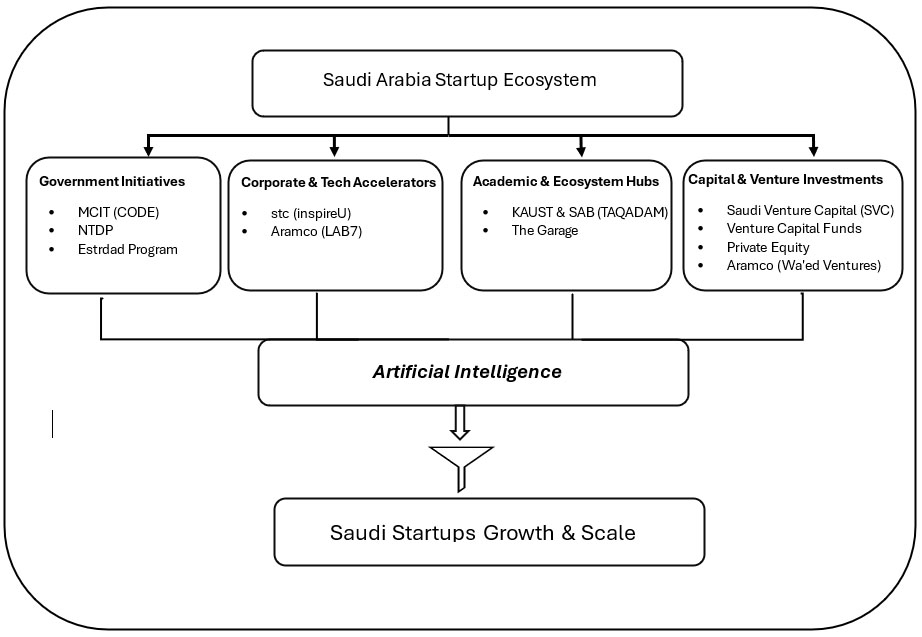
The support ecosystem has expanded significantly. Business accelerators and incubators such as stc’s inspireU, Aramco’s LAB7 and Wa’ed Ventures, TAQADAM by KAUST and SAB, The Garage, and CODE provide entrepreneurs with mentorship, infrastructure, networks, and market opportunities. Government initiatives have also reduced administrative and financial barriers. Programs such as Estrdad, which reimburses eligible startups and SMEs for certain government fees and costs, have made it easier to establish and develop businesses. The Ministry of Communications and Information Technology’s Center of Digital Entrepreneurship (CODE) supported more than 400 startups and delivered entrepreneurship and innovation services through over 220 programs and labs, while the National Technology Development Program (NTDP) operates under a SAR 2.5 billion budget to support technology-sector development through financial and non-financial initiatives.
At the same time, capital availability has increased sharply. Since 2023, Saudi startups have attracted more than US$3.4 billion in venture capital investment. In 2025 alone, approximately US$1.66 billion was deployed. According to the Ministry of Investment’s Saudi Startup Ecosystem Handbook, the Kingdom accounted for more than 55% of MENA venture capital investment for the third consecutive year.
Artificial intelligence is also reshaping the market. AI reduces the cost and complexity of building products, which allows more companies to enter the market faster, while also increasing competition.
These factors create strong opportunities, but they do not, guarantee success by themselves.
Growth Does Not Guarantee Success
Easier access to funding, support, and technology does not guarantee success. Artificial intelligence may accelerate the creation of startups, but it may also accelerate their failure. As AI makes it easier to build products, more companies can enter the market, including companies offering similar solutions with limited differentiation. This increases competition and puts greater pressure on startups to prove their real value.
In this sense, AI may act as a market filter. Companies that fail to adapt, build sustainable business models, manage their cash flow, or solve problems that customers genuinely value will disappear faster. At the same time, stronger companies can use AI to improve efficiency, reduce costs, and scale more rapidly.
Many startups also focus too much on rapid scale-up and lose sight of profitability. Some companies can continue spending more money than they earn for several years (cash burn) if they have deep pockets and large funding. Examples of this approach include large global companies such as Amazon and Tesla in their early years, as well as many AI startups today. Other startups need a clearer and faster path toward profitability, especially if they raise less capital. In Saudi Arabia, companies such as Jahez and Ninja have shown that it is possible to build strong businesses with a clearer focus on sustainable operations and profitability.
Startups may still need guidance and coaching on how to properly monetize their offerings and move toward profitability.
The New Startup Question:
Before AI, one of the major challenges was:
Can we build it?
In the AI age, the challenge is increasingly becoming:
Can we sell it? Can we retain customers? Can we build a sustainable and profitable business around it?
As technical development becomes easier to access, competitive advantage may increasingly move toward customer acquisition, distribution, business-model quality, market understanding, and the ability to solve a problem that customers genuinely value.
The key question may therefore become less about how advanced that technology is and more about:
How valuable is the problem the startup is solving?
Finally
Saudi Arabia has created a strong environment for startup growth. Investment, government programs, ecosystem support, and artificial intelligence are helping more companies enter the market. However, these factors mainly create opportunities. They do not guarantee successful outcomes.
The next stage of Saudi Arabia’s startup development should therefore be measured not only by the amount of investment or the number of new companies. It should also be measured by customer retention, sustainable revenue, profitability, business survival, and long-term value creation.
In simple terms:
- Investment growth shows the scale of the ecosystem.
- Ecosystem support (mentorship, accelerators, and government programs) makes entry and growth easier.
- Capital availability provides the fuel for growth.
- AI makes creation faster and competition stronger.
- Success requires customer value, a sustainable business model, strong execution, and the ability to move toward profitability.
References
- Saudi Venture Capital. (2025). The acceleration of the venture capital ecosystem in Saudi Arabia.
- Ministry of Communications and Information Technology. (2023). Saudi Arabia: Digital and technology sector overview. https://www.mcit.gov.sa/sites/default/files/2023-03/MCIT_DEC_23_En_V7.pdf
- (2026). FY 2025 state of venture capital in MENA. https://www.magnitt.com/research/FY-2025-MENA-VC-Report-51018
- Fintech News Middle East. (2025). Saudi Arabia emerges as a MENA startup powerhouse. https://fintechnews.ae/30509/saudi/saudi-arabia-emerges-as-a-mena-startup-powerhouse/
- Center of Digital Entrepreneurship (CODE). (2025). Annual Report 2024. Ministry of Communications and Information Technology. https://code.mcit.gov.sa/sites/default/files/2025-01/Code%20-%20Annual%20Report%202024%20V4.pdf

Murawwih Alanazi
Murawwih Alanazi is an Associate Consultant at Avalon Consulting, specializing in strategic transformation, requirements gathering, and process mapping. He has experience in business analysis, process improvement. Bringing a structured problem-solving mindset to every engagement, Murawwih has a deep interest in how artificial intelligence and market dynamics shape modern business strategy.