
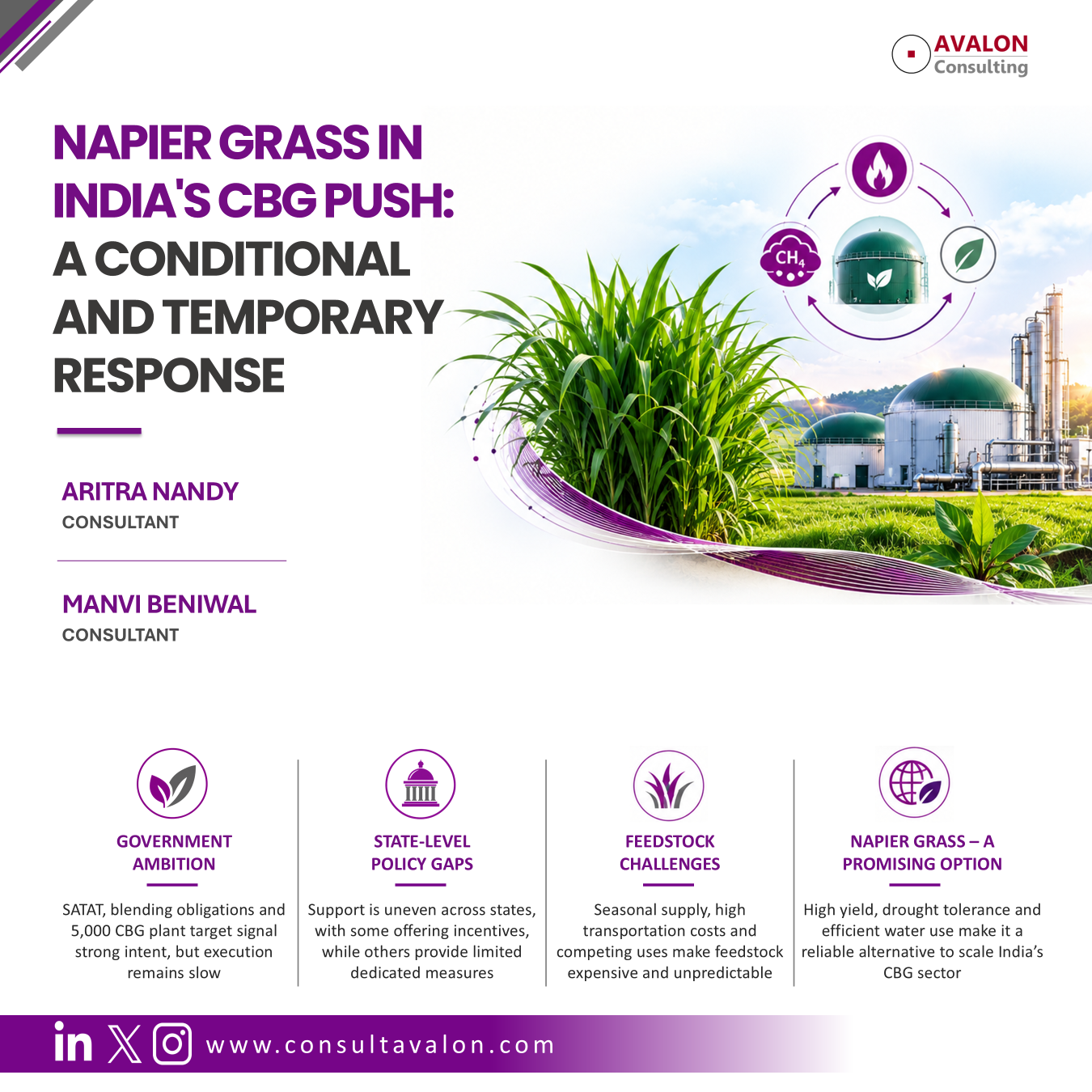
Aritra Nandy and Manvi Beniwal, Consultants at Avalon Consulting, examine the emerging role of Napier grass in India’s compressed biogas (CBG) expansion. With feedstock availability, seasonal supply constraints, rising logistics costs and uneven state-level policy support limiting the pace of CBG development, Napier grass offers a high-yield and relatively predictable alternative.
The article explores how its drought tolerance, efficient water use and short harvest cycle could help bridge early-stage feedstock gaps and improve plant utilisation. However, challenges around land economics, supply-chain infrastructure, pricing and sustainability mean its role should remain selective and transitional. For business leaders, understanding these trade-offs is critical to building a scalable and sustainable CBG ecosystem.
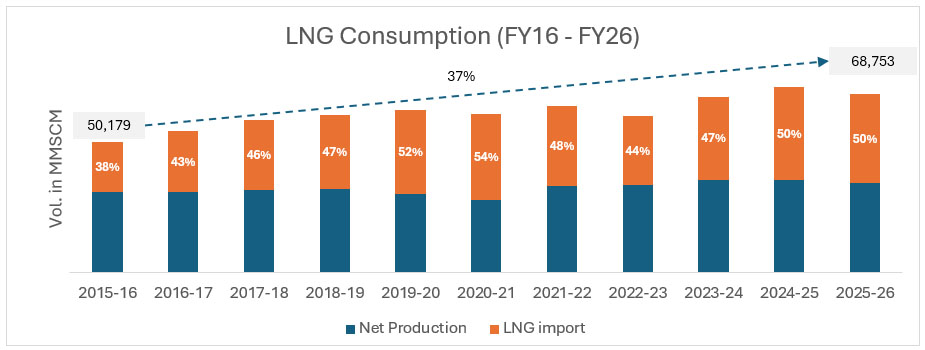
Over the last decade, India has put a higher emphasis on increasing the share of natural gas in its energy mix. Several of our domestic offshore assets are ageing, such as KG-D6, the production capacity of which has already started to plateau. In such a scenario, India’s rising dependency on imported LNG makes its energy mix more open to global price shocks and supply issues.
In an effort to derisk our supply chain and enhance our energy security, the government has responded with the promotion of compressed biogas (CBG) through initiatives such as SATAT. The government has also introduced CBG blending obligations, which target a phased increase from 1% to 5% in CNG (transport) and PNG (domestic) by FY29. An ambitious target has been set for the establishment of 5,000 CBG plants, which would have a potential production capacity of 40-60 MMTPA. However, the progress has remained rather constrained. The establishment of only 130 plants, against an LOI of more than 1000 projects, is a testament to the slow pace of execution. The disconnect between ambition and actual implementation makes it clear that, while there is a clear intent to scale the CBG ecosystem, targeted support will ensure the appropriate and required development.
Uneven state-level policy support & Feedstock Constraint
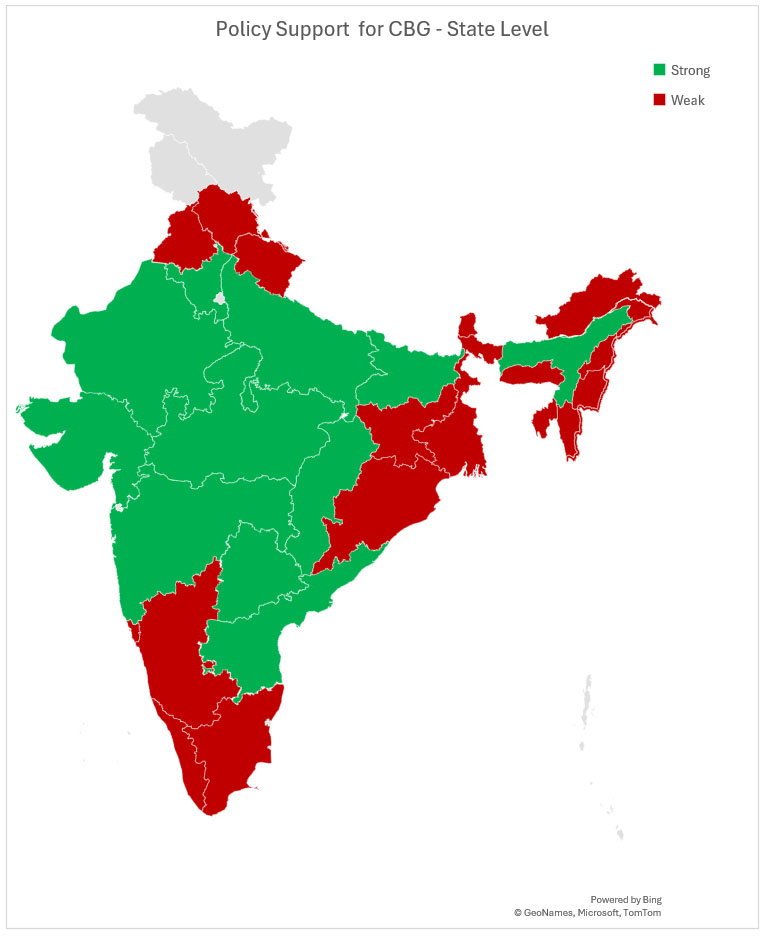
The growth of CBG in India continues to be limited by a combination of inconsistent state-level policy support and continual feedstock challenges. While some states such as Uttar Pradesh, Rajasthan, and Haryana have introduced measures like capital subsidies, tax exemptions, concessional land, and institutional support to encourage investment, other states offer limited dedicated support beyond central government schemes.
On the supply side, securing feedstock remains a major challenge. Agricultural residues such as paddy straw, wheat straw, and maize stalks are seasonal in nature, while press mud is concentrated around sugar mills, cattle dung is scattered across small farms, and municipal solid waste is often poorly segregated and collected. Such availability constraints, along with other issues such as rising transportation costs and competition from alternative uses such as the production of briquettes and pellets for thermal power plants during low supply seasons, have made and unpredictable.
Why Napier grass enters the conversation
Napier grass is a high-yield energy crop, which has the potential to generate 1 tonne of CBG from approximately 10 tonnes of Napier grass. Considering its short harvest cycle of 45-50 days, translating to 7 harvests per year, the effective yield surpasses that of other conventional feedstocks.
| Sr. No. | Feedstock | Feedstock Requirement (Per Ton of CBG) |
| 1 | Agriculture Residue | 10 T |
| 2 | Press Mud | 25 T |
| 3 | Bagasse | 10 T |
| 4 | Municipal Solid Waste | 20 T |
| 5 | Napier Grass | 10 T |
Considering its drought tolerance, efficient water consumption, and high methane potential, Napier grass poses as a reliable feedstock that could help address seasonal feedstock variability and support the expansion of India’s CBG sector.
Global experience with energy crops
At a global level, biomethane development has broadly followed two distinct models.
The United States and China have relied primarily on a waste-based approach, which uses manure, sewage sludge, landfill gas, and food waste to combine energy production with waste management.
Europe had a different approach, in which it focused on rapid scaling of biogas production through an intense focus on energy crops such as maize and grass silage, which are known for high, predictable methane yields. Soon after, the focus on energy crops started raising concerns over appropriate land use, environmental impact, and food security. This led to stricter sustainability regulations and a turn back toward waste and residue-based feedstocks. Large-scale plants such as BioEnergie Park (Germany) and Steimbker Biogas GmbH (Germany) had to convert from energy crop-based feedstock to the utilisation of residual feedstocks as a response to tightening regulatory limits.
The takeaway from this is that although energy crops can act as an accelerator for early biogas expansion, sustainability safeguards would be required to avoid environmental and policy risks.
Adoption of Napier grass in India remains selective.
India’s Napier-grass-based CBG development remains at an early, pilot-led stage. Chem Process Systems has inaugurated a plant in Dhrangadhra, Gujarat, positioned as a demonstration or early commercial facility. Additional projects are announced or under construction in Wardha, Maharashtra (Gruner Renewable Energy, with BioEnergy Germany) and Bareilly, Uttar Pradesh (Arciplug). These initiatives indicate growing industry experimentation with Napier grass as a feedstock. None, however, is yet independently confirmed in official registries as a large-scale, continuously operating commercial CBG plant. Adoption therefore remains selective and exploratory rather than mainstream.
The economic viability of Napier-grass-based CBG plants is reliant on a robust and localised feedstock supply chain. If we combine local feedstock infrastructure with long-term offtake agreements, guaranteed buy-back, and agronomic support, supply predictability improves, and logistics costs reduce.
Large-scale adoption in India nonetheless faces several structural constraints. Farmers remain reluctant to commit land to a long-term energy crop given the associated land-economics risk, and Napier grass’s high moisture content makes transport uneconomical beyond local catchments. There are also no mature biomass market or established price benchmarks, and yield variability combined with high upfront investment adds further commercial risk.
Clustered cultivation, , and strong developer support are what make deployment viable today, which for now confines adoption largely to pilot-scale projects.
- Standardised contract-farming frameworks: Introduction of legally enforceable contract templates, which would include clear pricing, quality standards, and dispute resolution mechanisms. This will be aimed at improving feedstock security and reducing investment risk. India can draw parallels from its regulated sugarcane procurement system, which has ensured a stable, predictable feedstock supply for decades.
- Support for aggregation and production infrastructure: Provision for capital subsidies for collection, baling, chopping, and ensiling facilities. This would reduce logistics costs and improve economic viability and supply reliability. Additionally, funding support for R&D to develop feedstock agnostic digesters, would add flexibility to the CBG plants.
- Farmer incentives: Direct monetary support such as input subsidies, concessional financing, and planting support can lower the upfront costs of Napier cultivation, encouraging adoption.
- Transparent biomass pricing: A regulated marketplace must be set up to improve price discovery, which will reduce uncertainty involved in procurement and build financing confidence.
- Marginal land utilisation: A higher emphasis needs to be given towards cultivation on degraded or low-productivity land. This can be achieved through simplified leasing frameworks paired with sustainability safeguards, thus ensuring competition with food crops stays at a minimum.
A conditional and temporary role for Napier grass
Considering the suitability and superior properties of Napier grass, it can serve as a transitional feedstock to help accelerate India’s CBG scale-up. This will help bridge early-stage feedstock gaps, ensuring improved plant utilisation and reduced supply risk. Its role, however, should remain supplementary and time-bound. The long-term CBG ecosystem must be rooted in waste- and residue-based feedstocks. This will ensure it remains economically and environmentally sustainable and does not affect food security.

Aritra Nandy
Aritra Nandy is a Management Consultant at Avalon Consulting, where he works on strategy engagements that help businesses drive growth through data-driven decision-making and structured problem-solving. He holds an MBA from IIT Delhi and a B.Tech in Chemical Engineering from RGIPT, and at Avalon has worked across market and competitive landscape assessments, product diversification studies, and commercial due diligence engagements. He is motivated by complex problem-solving and delivering impact through collaboration and structured insights.
Email: aritra.nandy@consultavalon.com

Manvi Beniwal
Manvi Beniwal is a Consultant at Avalon Consulting, specializing in Growth Strategy, Business Planning, and Market Assessment. She has worked across sectors including Chemicals, Environmental Infrastructure, Energy, and Retail, helping clients navigate complex market dynamics, identify growth opportunities, and drive data-backed strategic decisions. Her work is anchored in structured problem-solving and a strong focus on translating insights into actionable outcomes. Beyond her professional life, Manvi enjoys travelling and playing badminton.