
Utpal Kaushik, Senior Consultant at Avalon Consulting, shares his perspectives on how Artificial Intelligence is reshaping the future of business. In “From Horses to Highways,”
He explores how AI is enabling smarter insights, intelligent automation, enhanced human expertise, and greater business value. The article highlights why embracing AI is essential for organizations looking to drive innovation, improve efficiency, and build a sustainable competitive advantage in an increasingly digital world.
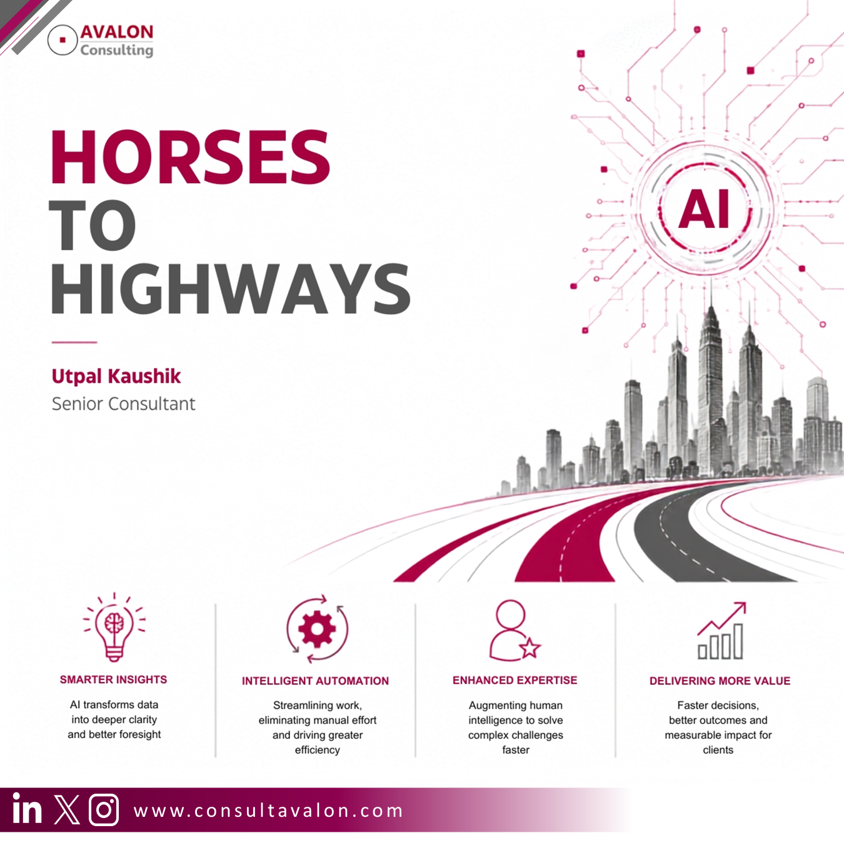
From Horses to Highways: Why AI Is the Automobile for the Modern Consultant
In 1865, Britain passed what was known as the Red Flag Act. Early self-propelled automobiles necessitated having a crew member to walk ahead, waving a red flag warning pedestrians and horse-drawn carriages of the approaching contraption.
Mobility at the time was muscle driven. Horse carriages powered locomotion. The early engines were loud and unpredictable. They spooked horses, disturbed streets, and were widely dismissed as impractical curiosities, perhaps even dangerous intrusions into civil order.
Innovation had arrived. Fear followed immediately.
Then, in 1908, when the Ford Model T rolled onto American roads, it did not merely replace the horse. It replaced hesitation.
Distance shrank. Opportunity expanded. Entire industries reorganized around a new idea, and mobility at scale.
The automobile did not jeopardize mobility as feared; it redefined it. Stable hands became drivers. Mechanics emerged where none had existed. Highways were built. Cities expanded outward. Humanity did not lose work; it discovered new forms of it.
Today, consulting stands at a similar inflection point.
Artificial Intelligence is our Model T.
Before cars, movement depended on human or animal muscles. Travel was possible, but constrained. Physical limits bounded ambition.
In the pre-AI era, consulting relied on cognitive muscle. Teams had to gather data manually, excavate insights from dense reports, synthesize insights slide by slide, and iterate tirelessly to refine recommendations. It was rigorous work, and it still is. But it was also bound by time and human bandwidth. AI changes that equation.
Where engines amplified physical strength, AI amplifies cognitive capacity.
Tasks that once required days of synthesis now take minutes. Scenario models can be simulated instantly. Patterns across thousands of data points surface in seconds. Drafts are generated rapidly, allowing consultants to focus not on assembling information but interpreting it. Recent studies indicate that generative AI is enhancing the productivity of knowledge workers by up to 40% when used effectively. That is not a marginal improvement. It is structural acceleration. But acceleration alone is not transformation. The real transformation lies in what consultants do with that speed.
When the automobile arrived, driving became a skill. Navigation became valuable. Roads had to be designed. Systems had to be coordinated. Mobility became an orchestration, not merely an act of movement.
Similarly, as AI handles more routine analysis, consultants’ responsibilities shift upward towards framing the problem, navigating the messy middle zones where data is partial, and politics is at play. And focus on values like trust, emotional intelligence and context sensitivity.
AI does not replace consultants. It removes friction between insight and action.
This is not the end of consulting’s pyramid; it is the evolution of its foundation. Junior consultants will spend less time formatting slides and more time learning to ask sharper questions. Senior leaders will have broader cognitive reach. Teams will iterate faster, think deeper, and test more hypotheses than ever before.
The consultant of the future is not diminished. They are augmented.
Every major innovation has first arrived with disruption.
Early humans likely burned their hands before fire became indispensable. Industrial machines displaced manual labour before they raised living standards. Cars were feared as loud, disruptive intrusions before they became everyday necessities.
AI evokes similar emotions today. The concerns are legitimate. Overreliance on machine outputs can dull discernment. Data governance and confidentiality demand vigilance. Energy consumption raises systemic questions. Skills, if neglected, can atrophy.
But history suggests that early friction is not failure; it is formation. Early automobiles were inefficient and unsafe as well. Roads were chaotic. Regulation lagged. Over time, safety standards improved. Infrastructure matured. Entire ecosystems developed around responsible use. Technology evolves. So do institutions. AI today is not the final form. It is the early engine.
The parable of consultants being doctors of the economy puts them at a central position in the architecture of modern economies. It is situated at the nexus of several industries, influencing strategy for the energy transition, providing access to healthcare, increasing manufacturing, stabilizing the financial system, and promoting education. The impact of a consultant is rarely limited to one company; instead, it spreads throughout communities, public institutions, and supply chains.If AI expands consulting capability, its effects do not stop at the engagement level. They radiate outward.
Decarbonization strategies can be stress-tested through intelligent simulation before capital is deployed. Healthcare systems can be redesigned using predictive analytics that anticipate strain rather than react to it. Infrastructure programs can be governed through real-time risk monitoring instead of retrospective audits. Public policy can be shaped through deeper scenario modelling that surfaces second- and third-order consequences before they materialize. AI does not merely make consultants efficient. It enables faster, more informed decisions across systems that affect millions.
There is a great level of optimism in the markets, with expectations of AI contributing trillions of dollars to global productivity over the coming decade. Trillions have flowed into companies developing AI. And even if the capital market experiences an AI correction, AI is smart enough to endure. It is not a mere allegory; we have precedents. The dot-com bubble burst in the 2000s, but the internet did not disappear. It evolved into a leaner, better governed and foundational to modern commerce and communication. The expectation of growth is not abstract nor some speculative exuberance. It represents better allocation of resources, smarter investments, and more responsive institutions. In that sense, AI is not just an industry tool. It is an infrastructure layer for human coordination, expanding our ability to analyze, decide and act at scale.
When cars became widespread, society did not ask, “Will humans become obsolete?” It asked, “Who will learn to drive?” The same question applies today. Consultants who champion the use of AI will not be passive observers of automation. They will be at the helm, orchestrating augmented intelligence, designing systems and processes that blend machine efficiency with human discernment. Future consultants will have to strategically use this silver bullet. Validate outputs with critical discipline, integrate machine-generated insights with lived experience, maintain ethical oversight where optimization meets consequence, and build trust in rooms where algorithms alone cannot persuade. Driving a car requires judgment. So does driving AI
Antiquity feared fire. Medieval craftspeople feared mechanization. Industrial workers feared machines. Each time, the immediate fear was displacement; the long-term outcome was expansion of human possibility.
AI is not a binary outcome; its impact is contingent on deployment. It is also not a universal solution. It is a strategic enabler that can help broaden analytical reach and free humans to focus on what machines cannot: judgment, empathy, synthesis, and creativity.
Just as the automobile, a century after its invention, is a core part of human life, now unimaginable to live without, AI stands to turbocharge insight generation and reshape how consulting adds value, not by doing what humans have always done faster, but by giving them bandwidth to actually think and do better work with greater impact.
The consultants who embrace this era will not be overtaken.
They will be the ones driving the future.

Utpal Kaushik
Utpal Kaushik is a Senior management consultant specializing in PMO enablement, business process design, and go-to-market strategy. He has worked with clients across consumer goods, renewables, and public services, helping simplify execution and scale delivery in complex operating environments. He brings a structured, problem-solving lens to digital and institutional transformation topics, with a particular interest in how sustainability systems thinking and shifting global dynamics are reshaping governance, identity, and access frameworks. Outside work, Utpal enjoys exploring theoretical physics and applied systems design, grounding his approach in both analytical rigor and curiosity.