Ayush Patodia, Associate Vice President at Avalon Consulting, shared his perspectives on the economics of fuel choices and the evolving role of ethanol and flex-fuel vehicles in India’s mobility transition, in an article published by NDTV.
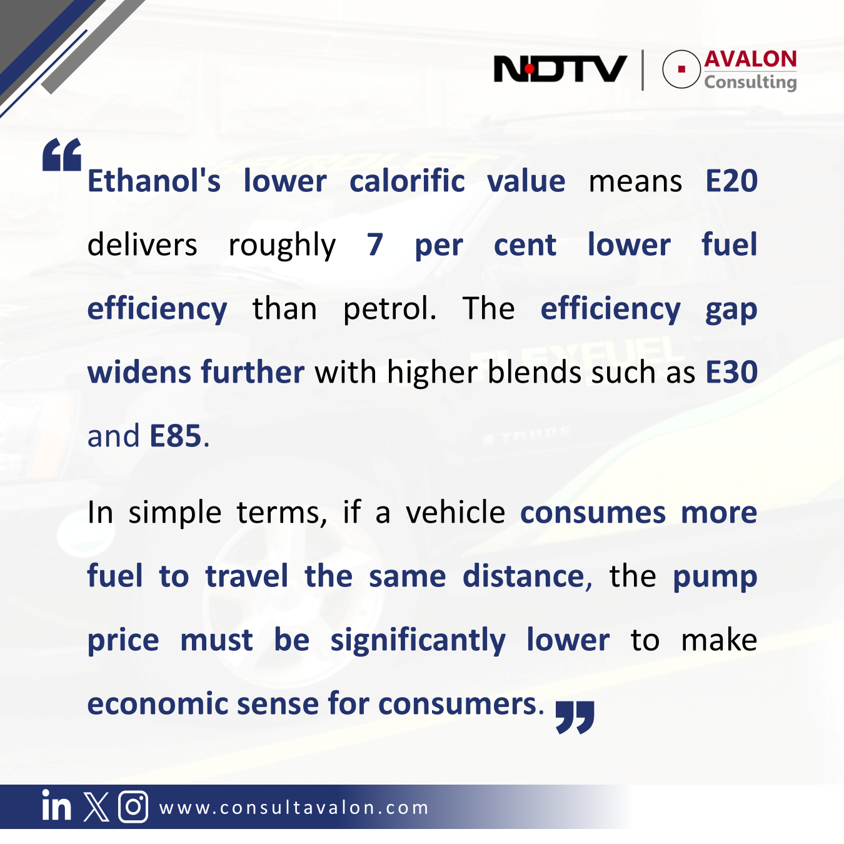
In the article, Ayush examines the key factors consumers should consider when choosing between petrol, ethanol blends and flex-fuel vehicles. While ethanol-based fuels support India’s sustainability and energy security objectives, he highlights that their lower calorific value results in reduced fuel efficiency compared to conventional petrol. For instance, E20 fuel delivers approximately 7% lower fuel efficiency, with the gap becoming more pronounced as higher ethanol blends such as E30 and E85 are introduced.
The article explains that lower fuel efficiency translates into higher fuel consumption for the same distance travelled. Consequently, the economic viability of ethanol-blended fuels depends on a sufficiently lower pump price to offset the increased fuel usage. Without an appropriate price differential, consumers may not realize meaningful savings despite the environmental benefits of higher ethanol blends.