

Pratyush Dash and Vidushi Goel, Consultants at Avalon Consulting, examine the rapid transformation of the anime industry from a niche entertainment segment into a global business ecosystem in an article published by The Economic Times.
Their article explores the key growth drivers behind anime’s worldwide success, including the rise of streaming platforms, intellectual property-led monetization, merchandising, gaming, and global fan engagement. It also highlights the structural challenges facing the industry, such as talent shortages and production constraints, while discussing how emerging technologies like AI could reshape the future of anime production and commercialization.
Anime’s Global Rise
The anime industry has expanded globally both in scale and relevance. Japanese animation industry has grown from $15.1 billion (¥1.83 trillion) in 2015 to $25.3 billion (¥3.84 trillion) in 2024 at a 10-year CAGR of ~6% according to the Association of Japanese Animations (AJA).
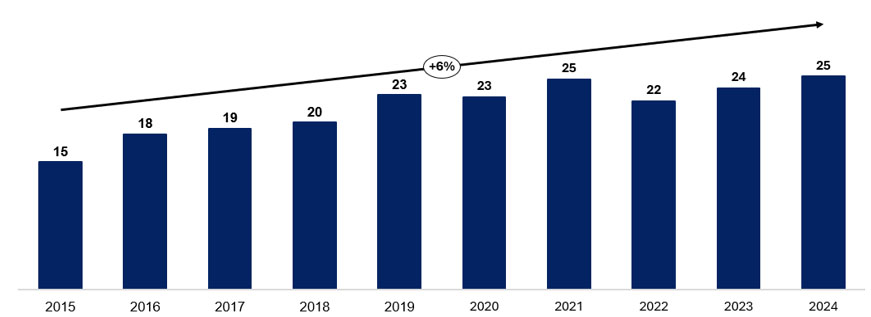
Illustration 1: Japanese Anime Market (2015-2024)1
What makes this growth particularly interesting is where it is generated. Anime is no longer driven primarily by domestic demand. The global markets account for 56% of total revenues for the anime industry, contributing $14.25 billion (¥2.17 trillion) in 2024, compared to 44% from Japan at $10.97 billion (¥1.67 trillion). Point to be noted is that the international demand is growing at a much faster pace i.e. 26% year-on-year, while domestic revenues grew a modest 2.8%.
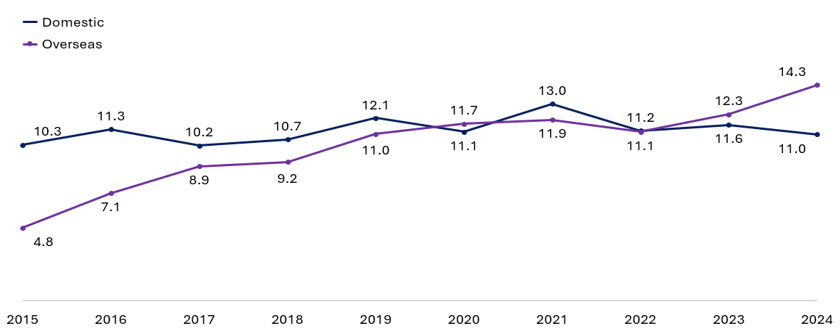
Illustration 2: Domestic vs Overseas Anime Market (2015-2024)1
Cultural and Commercial Expansion
At first glance, one might look at the Anime industry and think of only the anime content as part of the marketplace. In reality, it spans over a much wider ecosystem including streaming, merchandising, music, gaming, live entertainment, etc. In 2024, the biggest revenue contributing segment was global, followed closely by merchandising, reflecting how anime has evolved into a global IP-led business rather than just an anime content industry.
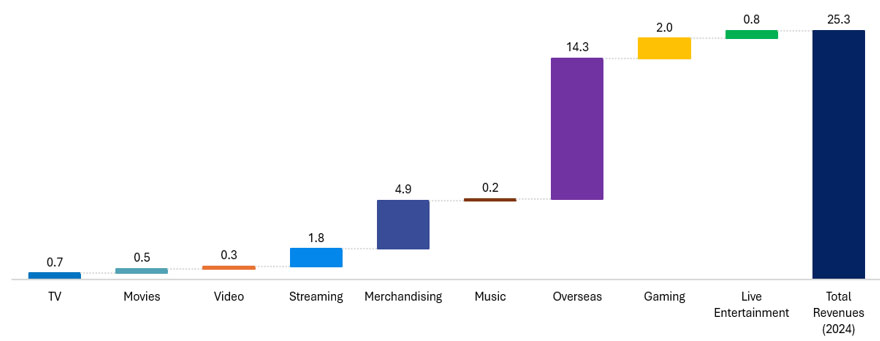
Illustration 3: Japanese Anime Market Breakdown by Segment (2024)1
Streaming platforms like Crunchyroll, which has the largest collection of anime, Netflix and Amazon Prime with limited editions and choices, have made anime more accessible than ever, bringing vast libraries of content to global audiences on demand. Nearly half of Netflix’s subscriber base engages with anime content, highlighting its mainstream appeal even though it has limited collection. At the same time, Sony’s bet on the category is paying off – its paid subscriber base has more than tripled since acquiring Crunchyroll in 2021.
This surge in popularity isn’t limited to viewership alone. It is converting into visible commercial returns for brands as well. Limited-edition drops and collaborations are seeing the butterfly effect of catering to wants of the loyal customers as well as the intrigue of the potential consumers. Certain brands are taking this move in the right direction, for example: Adidas’ Evangelion-themed sneakers sold out globally in minutes, while collections from Uniqlo (Demon Slayer) and Bershka (My Hero Academia) disappeared within hours of launch. These aren’t isolated or one-off successes but reflect the deep emotional connect fans have with anime as well as the interest it piques for some.
Luxury and lifestyle brands are also hopping on the bandwagon to stay culturally relevant. Gucci’s Doraemon collaboration for China and Dolce & Gabbana’s Jujutsu Kaisen line highlight how anime is influencing even premium aspirational segments. Meanwhile, watchmakers like Seiko and Casio G-Shock are tapping into the fandoms through character-inspired collections, further demonstrating anime’s growing influence across industries.
TV broadcasting remains a core revenue stream but has a shrinking share due to popularity of streaming services. According to Recording Industry Association of Japan (RIAJ), 465 anime music related CDs were released in 2023 alone making up 6.5% of all new Japanese music releases for that year. Collaborations between anime studios and gaming companies are making gaming a major monetization pillar. Live events have become an excellent medium for ancillary revenue growth.
Resounding Success of Anime Movies at the Box Office
If one thought of anime movies creating a new category and hence taking its own time to reach the popularity of the already established categories, then the times have emerged, and Anime movies are now competing head-to-head with major global titles. Demon Slayer: Infinity Castle stands out as a defining example, establishing itself as the seventh highest-grossing film of 2025 with global earnings surpassing $792 million. In just 3 days, with its opening performance alone, it clocked $70 million, placing it among the biggest debuts for any anime film. Strong fan anticipation was evident, with most tickets sold in advance. EntTelligence data, cited by Deadline, indicates that premium formats such as IMAX and PLF accounted for approximately 44% of the total box office revenue.
The momentum isn’t limited to a single franchise. Another movie, Chainsaw Man: Reze Arc has also delivered impressive performance, with worldwide earnings of $139 million and has made it into the top 20 highest-grossing anime films of all time surpassing popular shows like Pokémon: The Movie 2000. These releases signal a clear shift from fan-driven to global blockbusters.
Shift of Production Beyond Japan
Anime production isn’t limited to Japan anymore. Manhwa (Korean) and Donghua (Chinese) are gaining popularity worldwide. Solo Leveling, which is a manhwa, witnessed huge success globally and won the Anime of the Year award for the year 2025 by Crunchyroll. Even Donghua hits like Lord of the Mysteries earned praise for its cinematic storytelling and game play like animation.
Cracks Beneath the Surface of Anime’s Success
Despite its rapid growth, the anime industry faces deep structural challenges. A significant portion of the workforce remains underpaid with nearly 40% of professionals earning less than $15,400 (¥2.4 million) annually as determined from a study by Nippon Anime & Film Culture Association, far below Japan’s average salary of around $49,000 (¥7.7 million) according to OECD’s estimate. Animators are facing strain due to long working hours and intense production schedules. This has led to studios facing backlash over working conditions. This situation is further compounded by a serious talent shortage, as rising global demand has led to more anime projects than studios can realistically handle. Many studios have gone bankrupt due to thin margins and severe manpower shortage.
AI can help in mitigating these constraints. It can help to automate repetitive tasks like background art and coloring thus assisting with storyboarding. This will help in significantly reducing production time thus allowing creators to focus more on storytelling and character development which is the true essence of anime. Toei Animation has launched an AI assisted Background studio using tools like Midjourney and Stable Diffusion for filler episodes to reduce burden on animators. AI has the potential to ease capacity constraints and bring much-needed efficiency to an overstretched industry.

Pratyush Dash
Pratyush Dash is a Consultant at Avalon Consulting. He is a consulting professional with almost 4 years of experience in Growth Strategy, New Market Entry, Digital Transformation, Revenue Augmentation, Performance Improvement and Business Process Re-Engineering across diverse sectors such as Energy & Natural Resources, Automotive, Chemicals, Retail and Agribusiness.
Email: pratyush.dash@consultavalon.com

Vidushi Goel
Vidushi Goel is a Strategy Consultant with over 4 years of diverse experience in Organizational Transformation, Governance Design, Business Process Optimization, Human Capital Strategy, Digital Transformation, and Operating Model Design across public and private sector organizations.