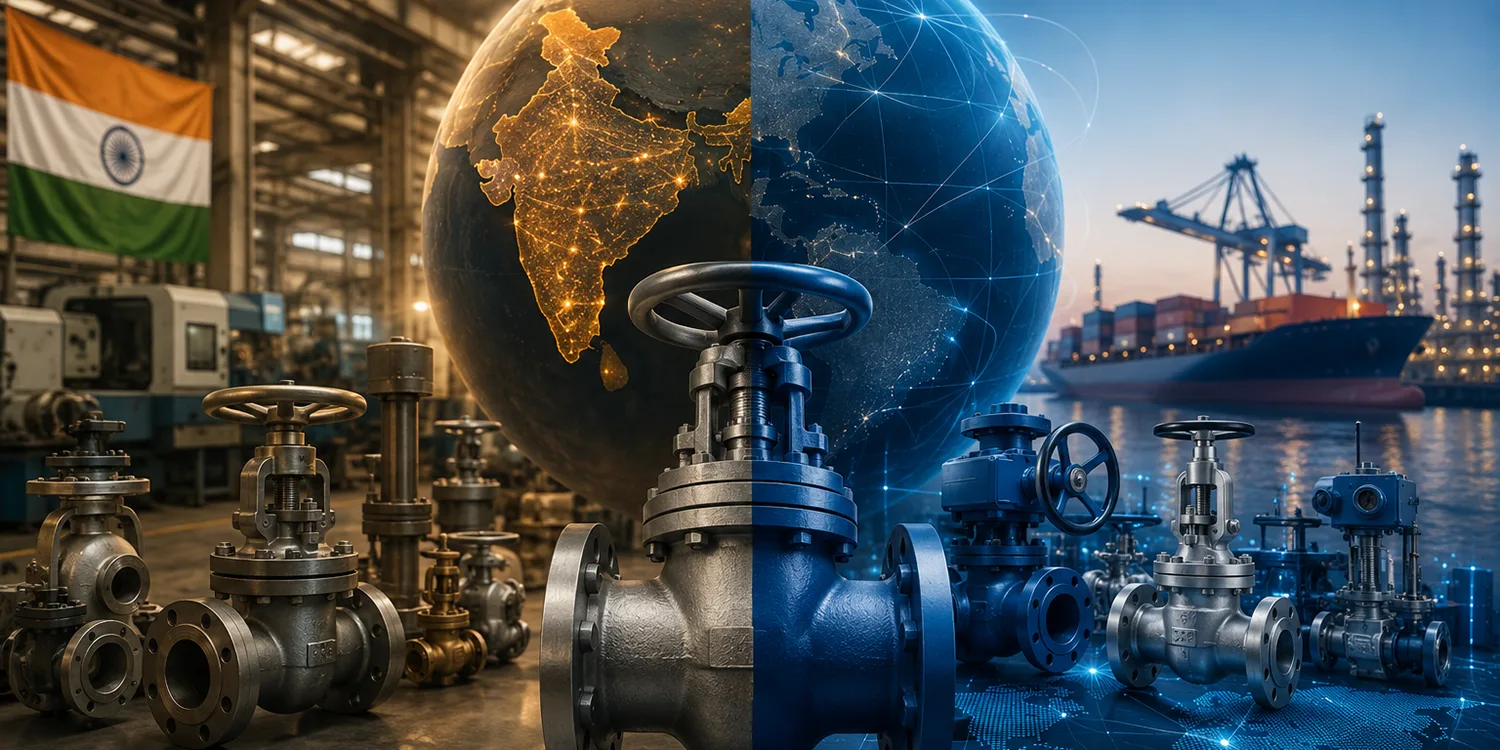
Bibhu Prasad, Associate Vice President, and Priyabrata Mohapatra, Senior Consultant at Avalon Consulting, shared their perspectives on how Indian valve manufacturers can strengthen their position in the global industrial supply chain in an article published in Chemical Industry Digest.
They emphasized that while India’s industrial valve market continues to expand on the back of infrastructure development and industrial growth, long-term global competitiveness will depend on building capabilities beyond domestic demand. The authors highlighted that fragmented industry structures, quality perception challenges, and complex international certification requirements continue to limit Indian OEMs’ penetration into premium markets in Europe and North America.
The market size of industrial valves in India is around INR 30,000 Cr, and is expected to reach INR 42,000 Cr by 2030 at a steady CAGR of 7%. The sector’s topline numbers seem encouraging yet it might not be a real measure of sector’s global competitiveness.
The key question as domestic valve demand portrays a rosy picture still remains unanswered which is, are Indian OEMs building the capabilities that will earn them a place in the premium global supply chain or are they merely riding the infrastructure spending wave that might eventually recede, leaving them stranded in price-sensitive, margin-thin segments? Our assessment, informed by both the market evidence and the strategic logic, is that the window for structural transformation is open but not indefinitely.
This article explores four pillars that define the path from peripheral supplier to trusted global partner which can potentially be a necessary intervention that this paper argues is long overdue treating India’s demanding industrial operating environment not as a liability to manage, but as a proving ground to build credentials for the export market.
1. The Indian Valve Market: Scale Meets Structural Complexity
India’s industrial valve market has shown sustained growth supported by end-use sector performance across oil and gas, utilities, chemical processing, etc. Ball valves lead the product mix in India with approximately 26% share, favoured across refineries, gas supply lines, chemical reactors, etc for their tight shut-off at capabilities and ease of automation. Quarter-turn valves collectively (ball, butterfly, plug, etc) command 40% of the market.
However, beneath these encouraging numbers lies a more nuanced reality. The market remains characterized by an unorganized fragmented base of small and medium players in which quality inconsistency is not just an occasional occurrence. Many manufacturers, particularly in the unorganized segment, resolve the tension between cost and capability by sacrificing the latter. This creates a compounding trap i.e. compromised quality reinforces international perceptions of unreliability, which creates a barrier to access the premium markets, which in turn limits the revenue base needed to fund capability investments.
Even the organized players while having made genuine strides in quality management systems, test and certifications, continue to face structural barriers in penetrating high-value North American and European markets.
2. The Export Challenge: Perception vs Reality
India exported approximately INR 2,800 Cr of valve products to 98 countries during H1 of 2025. The Middle East, particularly Saudi Arabia remains the primary export destination, followed by Southeast Asia. Yet export success remains limited to specific product categories such as ball and globe valves and specific geographies such as the Middle East. The key challenges to access the premium markets such as Europe and North America is highlighted below
2.1 Regulatory and Standards Complexity
Global valve markets operate under multiple, sometimes conflicting standards regimes. End-users from North America prefer API standards with stringent testing requirements mentioned in design specifications, while end-users from Europe prefer ISO standards with different acceptance criteria as compared to North America. Managing this complexity requires substantial investment in testing infrastructure and technical expertise
2.2 The Perception Gap of Quality
Despite possessing advanced manufacturing capabilities, Indian valve manufacturers continue to struggle with perceptions of quality inconsistency. One of the major export challenge that Indian OEMs face is the negative image of product quality, even when actual performance of the product meets the required specifications.
3. The Domestic Imperative: Opportunity Cost and Capability Erosion
While export challenges highlight the need of rigorous product testing and compliance to standards, the domestic market presents equally complicated market from a strategic standpoint. India’s rapid industrialization and infrastructure investment cycle has created substantial valve demand and therein lies both the opportunity and the trap i.e. domestic demand can sustain a business without forcing the capability investments necessary for global competitiveness. For example, a manufacturer who can win municipal tenders domestically has limited immediate incentive to invest in API certification or fugitive emission testing infrastructure.
This creates what we would characterize as a capability erosion dynamic leading to gradual widening of the gap between what Indian manufacturers can offer and what premium global markets require. The gap compounds quietly, and by the time it becomes visible in revenue terms, it is too late.
Even the global players establishing manufacturing operations in India usually rely on their established global supply chains for valve procurement not primarily because of quality concerns about Indian suppliers, but because the qualification process for new suppliers is time-consuming with limited bandwidth for actual execution. Hence, Indian OEMs which proactively invest in the technical documentation, sampling and testing required to pass qualification processes of global firms stand to gain not just revenue, but the reference credentials that high value international geographies require.
4. From Peripheral Supplier to Trusted Partner: A Strategic Roadmap
The central argument of this article is that Indian valve OEMs can transcend current limitations by reframing the ‘Made for India’ positioning as a proven credential that carries genuine technical credibility. India’s industrial operating environment is authentically demanding with extreme temperature and humidity variations, voltage fluctuations in plant utilities, water quality that accelerates corrosion in pipelines and flow control systems, unplanned maintenance cycles that test design robustness under conditions no laboratory can fully replicate.
Valves that perform reliably across Indian petrochemical plants, thermal power stations, chemical processing facilities are demonstrating resilience that objectively exceeds requirements in more controlled Western operating environments. This is not a marketing gimmick but an engineering reality.
Pillar 1: Building Certification and Compliance Infrastructure
Successful global penetration requires a sequenced, market-by-market approach to certification investment. Attempting to simultaneously meet API, ISO, CE, etc or country-specific regulatory requirements demands resources that most Indian manufacturers especially small and medium ones which forms the majority of the supplier base cannot realistically deploy. A phased approach hence can help appropriate allocation of investments.
Phase 1 – Middle East and Southeast Asia: India already exports to these markets and it is easier for Indian OEMs to navigate their regulatory frameworks. For example, ARAMCO’s rigorous vendor qualification, can be a credible gateway to penetrate into other GCC markets and create documentation habits that support subsequent API certification.
Phase 2 – Selective North American Entry: API certification such as API 6D (for piping valves) and API 607 (fire safety) requires a robust quality management systems aligned with API Q1 specifications. Significant investment is required but the market access can be potentially attractive
Phase 3 – European Market Access: EU markets require CE marking, ISO certifications and navigation of country-specific regulations. The investment threshold is the highest of the three phases, but European markets are distinguished by a genuine willingness to evaluate suppliers on total cost of ownership a framework in which Indian manufacturers, with documented lifecycle performance data, can compete meaningfully. For example and European buyer who is managing a 15-year asset lifecycle will be different from the one awarding a price-sensitive municipal tender and requires a correspondingly different engagement approach.
Pillar 2: Strategic R&D and Innovation Investment
The R&D investment thesis for Indian valve OEMs should be built around three domains where India’s operational experience creates genuine differentiation potential.
- High-pressure, high-temperature and corrosive applications: India’s chemicals manufacturing (specialty and bulk) sector, power plants, refineries operate valves under extreme conditions that have produced hard-won engineering knowledge. Formalizing this experience into documented collaterals can help establishing a reliable track sector for these demanding industrial applications
- Smart valve integration: Operations of actuated valves under fluctuating power supply, integration of IoT, real time data analytics can help building differentiation which can support establishing credentials and IP on a global level
- Application-specific solutions: Rather than competing in high volume general-purpose uses, Indian manufacturers can identify niche end-use applications such as cryogenic service, corrosive media handling, double block and bleed configurations, cleanroom requirements for semiconductors where specialized knowledge creates high value differentiator
Pillar 3: Build to Print and Contract Manufacturing Capabilities
Build-to-print manufacturing which specifically means producing components to exact customer specifications with documented zero-deviation traceability represents a strategic opportunity that is structurally different from standard commercial valve production. In specialized industrial applications, consistency and traceability are not quality preferences; they are contractual requirements.
The capability requirements are specific: advanced CNC machining centers capable of holding tolerances to exact specification, statistical process control embedded in manufacturing operations, standardized documentation and traceability systems and the technical expertise to interpret complex engineering drawings and translate specification intent into production reality.
Indian manufacturers who can build these capabilities may find that the qualification process, while demanding, is achievable and that the customer relationships are stickier and more attractive margins than standard commercial supply.
Pillar 4: Supply Chain and Quality Assurance Transformation
Achieving operational excellence is one of the major factor to develop global competitiveness. This requires strategic transformation of supply chain and quality control processes.
Leading practices that Indian manufacturers should adopt include:
- Supplier Development Programs: Rather than accepting variability in raw materials and components as inevitable, manufacturers should invest in developing their supplier networks, cascading quality requirements and providing technical support to ensure consistent inputs
- Statistical Process and Quality Control: Moving beyond final inspection to continuous monitoring which may help improving consistency, and provides the data necessary to demonstrate capability to demanding customers.
- Advanced Testing Infrastructure: Installation of fugitive emissions testing, fire-safe testing, performance validation under extreme conditions provide both product quality insights and generate customer confidence
Conclusion: Synthesizing Make in India and Made for India
Indian valve manufacturers must synthesize both concepts: leveraging the national initiative “Make in India” while capitalizing on the reliability and robustness that emerges from India’s demanding operating environment (Made for India).
The premium global valve market offers opportunities only for capable, certified and strategically positioned suppliers. Indian OEMs have latent strengths like technical talent, cost-competitiveness and experience in challenging environment. Converting these strengths into compete globally requires strategic clarity, smart investments and operational excellence.
This transformation is neither easy nor guaranteed. It demands resources, commitment and clear strategic direction but alternatively to be in price-sensitive segments with limited growth and eroding profitability is also unsustainable. The time to begin this transformation is now, while market conditions support this opportunity.

Bibhu Prasad
Bibhu Prasad is an Associate Vice President at Avalon Consulting. He is a consulting professional with over 10 years of diverse experience across Growth Strategy, Performance Improvement, and Digital Transformation across Metal and Mining, Agribusiness, Chemicals, FMCG, Automotive and Transportation sectors.

Priyabrata Mohapatra
Priyabrata Mohapatra is a Senior Consultant at Avalon Consulting. He is a consulting professional with over 6 years of diverse experience in Go-to-Market Strategy, Growth Strategy, Performance Management, Governance & Compliance and Operational Excellence in diverse sectors such as manufacturing, automotive, IT BPO, metals & mining.