
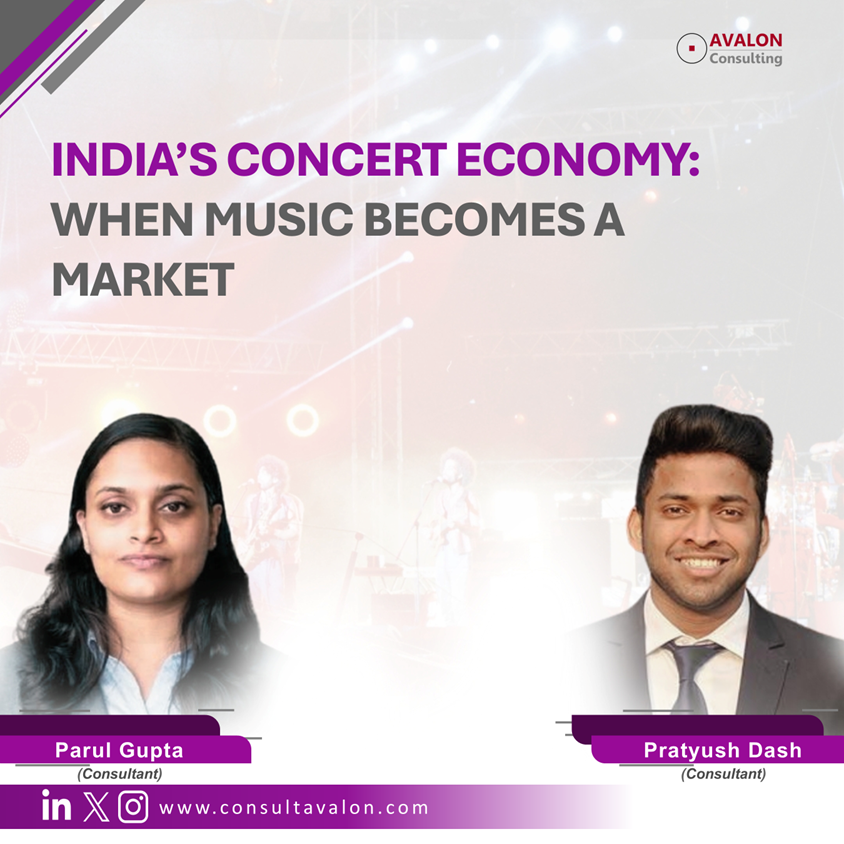
Parul Gupta and Pratyush Dash, Consultants at Avalon Consulting, shared their views on the rise of India’s live entertainment sector in the article “India’s Concert Economy: When Music Becomes a Market.”
They highlighted that large-scale concerts are evolving into powerful economic engines, driving tourism, hospitality, retail, and job creation, as seen in major events that generate significant local spending and infrastructure activity. The article notes a broader cultural shift, with younger consumers increasingly prioritizing experiences over material purchases, fueling sustained demand for live events across both metro and tier-2 cities.
On a crisp January night in Ahmedabad, as Coldplay’s Chris Martin sang “A Sky Full of Stars” to a stadium packed with more than a hundred thousand fans, the roar that followed wasn’t just about music. It was the sound of a new market awakening. Over two nights, the Narendra Modi Stadium hosted 2,22,000 people in what became the largest stadium concert of the 21st century. Hotels sold out, flight fares skyrocketed, restaurants reported their best weekends in years, and taxis doubled their rates without losing customers. By the time the lights dimmed on Coldplay’s “Music of the Spheres” tour, the city had registered an estimated economic impact of ₹641 crore, including ₹392 crore in direct local spending and ₹72 crore in GST revenue.
This was not just a concert. It was a case study in what Prime Minister Narendra Modi recently called the “concert economy”, the idea that live music has moved beyond art and fandom to become an economic engine in its own. “A country with such a huge legacy of music, dance, and storytelling is also a huge consumer of concerts. There are many possibilities for the concert economy,” Modi declared at the Make in Odisha Conclave in early 2025. His remarks came after Coldplay’s shows set new benchmarks, but the prime minister’s framing was clear: India is no longer just hosting concerts, it is building an industry around them.
From Swiftonomics to Coldplay in Ahmedabad
The term “concert economy” echoes a global trend that first drew attention with Taylor Swift’s Eras Tour. Economists coined “Swiftonomics” to describe how her concerts sparked travel booms, sold out hotels, and injected billions into local economies. In the U.S., her tour generated an estimated $4.6 billion, with ripple effects across tourism, retail, and services. In Britain, her performances added nearly £1 billion to GDP. Singapore even struck an exclusive deal with Swift, paying millions per show to ensure fans from across Southeast Asia flew in.
India’s Coldplay moment was the local equivalent: a glimpse of what happens when global stars meet an audience base that is young, cash-ready, and hungry for experiences. Around 86% of the attendees travelled from outside the city of Ahmedabad. In three days, the airport handled around 1,38,000 passengers, trains ran with record waitlists, and hotel room rates soared to as much as ₹90,000 a night. Cab bookings surged to over 400%. There was a footfall growth of 40% in the restaurants.

Illustration 1: India’s Concert Spending Snapshot
A Cultural Shift, Not Just an Economic One
The momentum is not only about money. It is about a generational pivot. For many Indians, particularly urban millennials and Gen Z, concerts are no longer one-off treats but social milestones. Where earlier generations saved for property or gold, this one spends on experiences, on being part of a moment.
Industry insiders point to a post-COVID behavioural shift. Social currency has replaced thrift as the marker of status. Fear of missing out, the dreaded FOMO, drives ticket demand as much as musical taste.
Platforms like BookMyShow and Zomato’s District have made ticketing seamless. Integrated digital infrastructure allows for advance sales, tiered pricing, VIP experiences, and even livestream options. At Coldplay’s Ahmedabad show, the live stream drew 8.3 million views and clocked 165 million minutes of watch time.
The Boom Spreads Beyond Metros
Perhaps the most surprising feature of India’s concert economy is how quickly it is moving beyond Delhi, Mumbai, and Bengaluru. In 2024 alone, there were 30,687 live events held across 319 cities, with tier-2 cities witnessing a 682% growth in shows.
This geographical shift has powerful consequences. Each major concert in a smaller city can create 15,000 – 20,000 temporary jobs, from logistics and security to digital media and artist liaison. About 10 – 15% of these roles are already converting into full-time. A global talent solutions firm projects that India’s concert economy could generate 12 million jobs by 20324.
For local governments, every event is a chance to improve a city’s popularity, boost its tourism, and support local businesses. The Tourism department of Gujarat utilized the weekend in which Coldplay performed to showcase the city’s heritage. They promoted the handloom bazaars and the street food scene, showcasing the city’s traditional offerings. In Jaipur, Diljit Dosanjh’s concert led to the city subsequently receiving the Indian Film Academy Awards.
The Money Trail
For brands, concerts are no longer about logo placements but about emotional association. Kotak Mahindra Bank, for instance, has backed nearly every major international act in recent years, citing a 30 – 40% increase in customer engagement from sponsorships. Ticket sales and sponsorships make up the bulk of concert revenues, contributing nearly 80%.

Illustration 2: Breakdown of Concert Revenue Sources
Meanwhile, talent fees drive the costs, which can consume 60% of a show’s budget. Coldplay, like most global acts, travelled with their own crew, equipment, and stage design. Promoters must add venue costs, sound and lighting vendors, crowd security, and insurance. Profit margins can be slim; 10% is considered respectable, unless sponsorship is strong. An artist’s popularity is a key factor determining whether an event breaks even or records a profit.
Indian artists like Arijit Singh, Honey Singh, and Diljit Dosanjh charge lower fees than international artists while attracting crowds that match or surpass them in tier-2 cities. Higher ROI is generated from such events. In effect, while international stars are the catalysts, Indian performers are the spine of the domestic concert economy.
The Roadblocks Ahead
For all the promise, India’s concert economy faces some constraints. There are fewer than a dozen purpose-built arenas with capacities of over 10,000. Licensing is cumbersome, with 10 – 15 approvals required from various authorities. High GST rates, which are now reduced to 18% still pinch. Independent artists still struggle to find platforms. The amount of waste that is generated from the stadium after the concert is a matter of concern, and last but not least, there is no measure to determine how many tickets are sold in black.
A Blueprint for the Future
Yet optimism prevails. The Coldplay concert showed what is possible when planning, technology, and governance align. Special Trains, extended metro services, sustainability, and turf protection measures demonstrated a city adapting to global standards. Accessibility initiatives like vibration jackets and sign-language interpreters for the hearing-impaired set a benchmark for inclusivity.
The next step is to institutionalize these lessons. Public-private partnerships could fund multi-purpose arenas. A single-window clearance for events could replace the maze of permissions. Training programs in sound, lighting, and stage management could professionalize the workforce. And standardized impact assessments like the Ahmedabad study could help cities compete to host global tours by proving the economic returns.
More Than Money
Ultimately, the concert economy is about more than GDP. It is about how culture and commerce intersect to create a shared meaning. On January 26, Coldplay and Jasleen Royal led over 1,00,000 people in singing Vande Mataram, demonstrating how music can boost civic identity, national pride, and international visibility.
By 2030, if India sustains the momentum, it could be among the top five live entertainment markets worldwide, with revenues approaching ₹15,000 crore. But the true measure will lie in the stories people tell of achieving a milestone.
In that sense, India’s concert economy is not just about swelling balance sheets. It is about the lights going down, the first chord striking, and tens of thousands of strangers singing in unison. That sound is both an anthem and an economy in the making.