Raghav Bansal and Rathin Sarmah, Consultants at Avalon Consulting, shared their views on India’s mobility transition in the article “India’s Dual-Track Strategy: Why E20 and EVs Together Power the Future?”
They highlighted that E20 ethanol blending and electric vehicles, often seen as competing solutions, are in fact complementary pathways for reducing emissions and crude-oil dependence. While E20 serves as a near-term bridge by leveraging existing infrastructure and supporting rural incomes, EVs represent the long-term shift toward cleaner, electricity-based mobility.
Further, they suggested that a balanced, multi-fuel strategy combining ethanol adoption with accelerated EV infrastructure, renewable energy expansion, and supportive policies is essential for ensuring an inclusive, secure, and sustainable transition of India’s transport sector.
The two shifts in mobility for India – the E20 ethanol-blended fuel and electric vehicles (EVs), may seem to represent contradictory approaches at first glance. On one hand, E20 focuses on making fossil fuel use cleaner by blending ethanol to reduce emissions and increase security. On the other hand, EVs aim to make fossil fuels redundant by transitioning transportation to electricity. The major choice between the two or integration of both requires understanding India’s infrastructural readiness.
Expanding E20 ethanol blending prepares infrastructure, supply chains, and consumer habits by diversifying energy sources and incentivizing farmers, thus reducing reliance on crude oil in the near term. This also builds awareness and acceptance of alternative fuels. Meanwhile, accelerating EV adoption especially in urban centres runs in parallel, supported by expanding charging infrastructure and policy support. This dual pathway ensures a smooth, socially inclusive transition with cleaner fossil fuels acting as a bridge and enabling broader EV adoption as infrastructure and affordability improve over time.
Potential and Practicality
India achieved its target of 20% ethanol blending (E20) in 2025, much earlier than the planned 2030. This is due to the government’s strong push in implementation and promoting the production of ethanol from crops like sugarcane and maize, through its programs like Modified Ethanol Interest Subvention Scheme, the Removal of Production Caps for Ethanol and the Expansion of Feedstocks and Policy Flexibility.
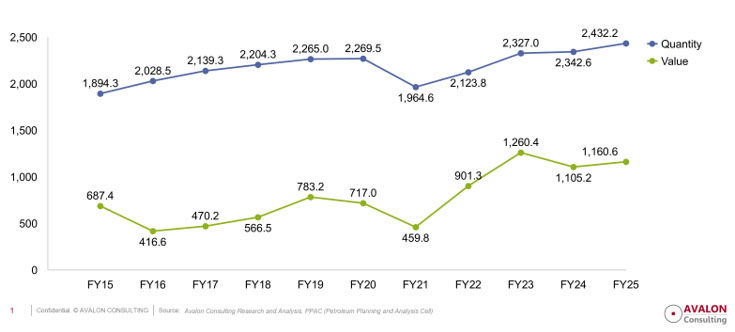
Ethanol blending brings pronounced economic and environmental benefits. At 20% blending, the crude required for petrol production drops to 80% which leads to savings in crude imports. Till date, the ethanol blending program has substituted 245 lakh tonnes of crude and saved over USD 16 Bn in foreign exchange.
Quantity and value of crude imports in India from FY15 to FY25 showcase a dip post FY23 due to increased E20 ethanol blending
Quantity (in Lakh Metric Tonnes) and Value (in INR ‘000 Crores)
Another economic benefit of ethanol is that it can be made from molasses and grains that are unfit for human consumption and therefore have little alternative value. This essentially means that farmers can play a key role in managing and selling even their low-quality produce/inventory and get respectable money for it. In this regard, p
The high-octane number of Ethanol (RON ~108.5 compared to petrol’s 84.4) promotes clean combustion, which are important for modern high-compression engines. According to Ministry of Petroleum & Natural Gas, life cycle emission studies show that greenhouse gas (GHG) emissions using E20 have reduced by nearly 65% (sugarcane-based) and 50% (maize-based) compared to petrol vehicles. This translates to cutting
However as per Niti Aayog, it takes 2,860 litres of water to produce one litre of ethanol from sugarcane which causes increasing water stress and conflicting demands for drinking water and agriculture. This raises questions about sustainability, water scarcity, and the environmental effects of cultivating water guzzling crops like sugarcane for ethanol.
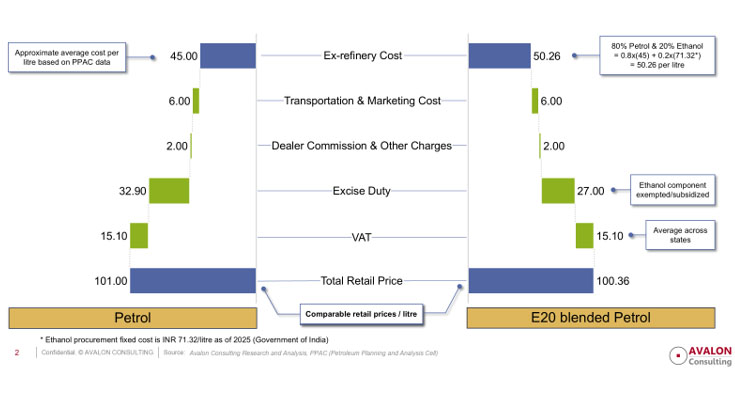
Early expectations that E20 would be cheaper than petrol have also changed now. Due to rising production costs and changing procurement dynamics, the average cost of purchasing ethanol has increased to INR 71.32 per litre as of 2025, which makes E20 almost as expensive as petrol and occasionally even more so (see chart).
Despite expectation of reduced fuel cost, the unit economics for Petrol and E20 shows comparable retail price majorly because of changing procurement dynamics
Unit Economics for Petrol and E20 as of 2025 (in INR/litre)
According to ET Auto, while E20 offers better acceleration and higher engine efficiency, it also results in a typical mileage drop of 2–3% in newer cars and up to 6% in older ones. Ethanol’s tendency to absorb moisture in India’s humid climate creates risk of rusting, injector clogging, and faster wear of rubber components, especially in older cars.
The government addresses these concerns about E20 fuel efficiencies by emphasizing that mileage variations of 2-6% are generally observed based on vehicle design, driving patterns, maintenance practices, tyre pressure and alignment etc. and reaffirms that any downside of E20 is adequately balanced by advantages like enhanced energy security, reduced emissions, and improved acceleration.
Another objection to E20 is the compatibility of vehicles and the investment required in ensuring compatibility down the line. However, research by SIAM states that recent vehicles (especially BS6 and newer) and many earlier vehicles as well, have been compatible with E20 since 2009. The research further confirms that requirement of upgraded materials for older models is minor and minimal in value.
Electric Vehicles (EVs): Promise and Pragmatism
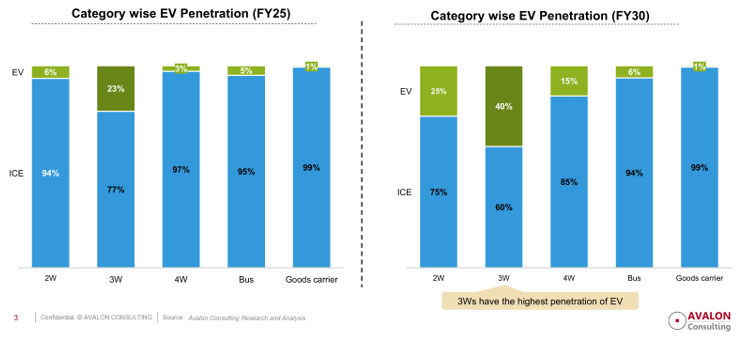
EV adoption in India has been continuously growing, with attractive government initiatives like FAME subsidies and NEMMP 2020. EV sales have grown by 28% YoY from 2023 to 2025 crossing total sales volume of 2 million units across all vehicle segments combined as per SIAM and VAHAN. EV Penetration is forecasted to increase significantly in 2Ws, 3Ws and 4Ws in the next 5 years.
The EV sales are dominated by 2-Wheelers, but 3-Wheelers have the highest segment penetration
EV Sales and Penetration
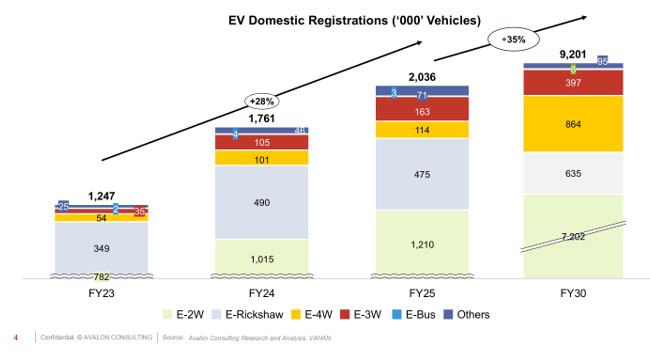
EV sales, led by 2-wheelers, grew at 28% CAGR over the past two years and are projected to grow at 35% over the next five years
EV Domestic Registrations
Government of India’s ambitious target is to achieve complete indigenisation of EV production through the ‘Make in India’ initiative and elevate the proportion of EV sales in private cars (30%), commercial vehicles (70%), buses (40%), and in 2Ws and 3Ws (80%) by 2030.
EVs offer nearly zero tailpipe emissions. This significantly aids in air pollution control while reducing dependence on crude oil imports but EVs can only provide real carbon savings when they are powered by renewable energy. Therefore, for EVs to transition from “clean-at-use” to “clean-in-production”, investments need to be done to increase India’s solar, wind and hydroelectric capacities. Only then will we be able to address the sustainability issues around EVs across their entire spectrum.
Still, challenges to mass EV adoption exist due to limited public charging infrastructure, especially in rural and semi-urban zones. EVs are relatively more expensive with limited range compared to ICE vehicles running on E20. EV batteries contain toxic materials like lithium, cobalt, and nickel which when disposed improperly, can leak into soil and groundwater, causing major contamination risks. Manufacturing EV batteries requires rare earth metals which need to be imported causing major dependency on China which produces over 90% of the world’s processed rare earths. Rapid market expansion still awaits technological breakthroughs, stable supply chains, economy-of-scale manufacturing and synchronization with the growth in renewable power generation, to avoid grid stress and ensure true emissions savings.
Conclusion: Multi-Fuel Transition, Not Binary Choice
E20 acts as a practical “bridge fuel,” allowing India to rapidly use its available agricultural resources to reduce its emissions and reliance on crude oil. Farmers and the exchequer have benefited directly since its implementation. But mileage loss and engine compatibility continue to limit its efficacy. Also, ecological concerns with the use of water-guzzling crops like sugarcane for ethanol production cannot be ignored. EVs on the other hand are environmentally superior but require large investments in charging infrastructure, renewable energy production and battery technology. A sudden switch to EVs will end up ignoring legacy ICE engine investments, leaving most of rural India without a viable transport option in the short-term.
India needs both E20 and EVs, for their unique benefits, as the country moves through this decade. E20 provides vital quick hold for environmental, rural, and fiscal goals, while long-term viability will be delivered by a robust shift to EVs with technology, infrastructure, and the renewable grid coming online. The future is a gradual, multi-fuel transition, with smart policy, consistent incentives, and adaptive infrastructure as the cornerstone.

Raghav Bansal
Raghav Bansal is a management consultant at Avalon Consulting, specializing in automotive sector analysis and business strategy. He has prior experience in digital transformation, customer satisfaction research for Indian OEMs, and process improvements. Bringing a structured problem-solving mindset to every engagement, Raghav has deep interest in how market dynamics shape modern business strategy.

Rathin Sarmah
Rathin Sarmah is a management consultant focused on driving growth and transformation through Market Assessment, Go-to-Market Strategy, and Organisational Transformation. He has worked with clients across automobiles, chemicals, and FMCG helping leaders size opportunities, sharpen strategic choices, and translate plans into clear execution roadmaps. Rathin brings a structured, problem-solving mindset to every engagement, with a strong interest in how evolving customer needs, competitive intensity, and operating model shifts are reshaping modern businesses.