

Treesha Lall, Consultant, and Ayush Patodia, Associate Vice President at Avalon Consulting shared their views on the evolving financial relevance of sustainability in the article “From Values to Value: Navigating the Evolving Financial Materiality of ESG Issues.”
They highlighted that ESG factors are no longer just ethical considerations but are increasingly becoming financially material, influencing risk, profitability, cost of capital, and investor decisions. The article emphasizes the concept of “dynamic materiality,” where environmental and social issues can evolve into core financial risks or opportunities over time due to regulatory changes, stakeholder pressure, and market expectations.
Further, they suggested that companies must integrate ESG into core strategy, sector-specific risk assessment, and disclosure practices moving toward an “EESG” approach that links sustainability directly to economic performance and long-term value creation.
Five years post the COVID-19 pandemic, the incorporation of Environmental, Social and Governmental (ESG) factors into company functioning has become critical. Increasing sophistication in measurement, disclosure policies and other regulatory mechanisms have led the charge in this revolution. Tech innovations have radically increased transparency on compliance. Regulators, customers and interest groups like prospective employees, NGOs and industry associations have begun creating an urgent impetus for companies to not just respond to growing ESG concerns, but to incorporate a proactive, forward-looking approach to ESG [i]. Traditionally sidelined as a check box ESG is now becoming a strategically significant and financially material tool for value-creation.
The term dynamic materiality has recently entered conversations around ESG. Given the greater availability, dissemination and response to information about ESG performance lapses, it has become critical for firms to understand the materiality of ESG, both at present and over time. It is crucial for proactive risk management and strategic planning.
Understanding ESG Materiality
Materiality, defined by SASB, refers to any information that could cause a reasonable investor to think differently about whether to buy or sell the stock. ESG materiality considers broader, indirect factors, such as GHG emissions, water and wastewater management, labor protection and systemic risk management.
While traditionally financial materiality refers to factors directly affecting economic risks and rewards, when looked on as an evolving concept, ESG issues can become financially material over time. An HBS report highlights the five steps through which this happens:
Chart: Stages of ESC Materiality

Source: Harvard Business School, 2020
Status quo prevails when a fundamental misalignment of customer and company interests prevails due to lack of information or norms that entail tolerating it. CFCs used in air conditioners, for example, were widely used before the 90s when information about ozone layer erosion was not available. Similarly, labor protections were not widely enforced in the sub-contracting based textile industry in India until after cases like the Sumangali scheme came to light through international reports from NGOs. In both cases, a catalyst force brought fundamental misalignments to attention, in the former case, due to new information changing societal expectations, and in the second, due to a firm’s major deviation from social responsibility.
The catalyst event soon triggers pressure from stakeholders. In the case of CFCs, the 1980s saw public interest groups like Green Peace and Friends of the Earth leading public boycott campaigns (No Future Without the Ozone) and blocking CFC shipments. Organisations like the NRDC in the US sued the Environmental Protection Agency (EPA) for stricter Ozone standards. In the Indian textile industry, similarly, it was found that under-age women were employed by factories with no freedom of movement, lack of wage security, medical care and fixed hours. This led to large scale campaigns boycotting brands such as Marks & Spencer and H&M for irresponsible sourcing (Clean Clothes Campaign, Labour Behind the Label Campaign).
Companies under intense scrutiny responded by making low-cost changes to prevent intervention or downplaying stakeholder concerns. In response to CFC concerns, DuPont, for example, dismissed ozone depletion as a theoretical risk . Brands associated with Sumangali Scheme plants pledged a code of conduct agreeing to third party auditing and implementing worker grievance mechanisms.
The last step clarifies the financial materiality that evolved for firms involved in both case studies. The Montreal Protocol signed in 1987 led to international commitments to phase-out CFCs. This led to many companies innovating alternatives. DuPont, for example, undertook an estimated USD 500 million R&D transition to HFCs (Hydro Flouro Carbons). The Sumangali Scheme led to Public Interest Litigations (PILs) by the Madras High Court as well as the enforcement of the Factories Act in Tamil Nadu – leading to costs of due diligence for firms, costs of factory reforms, for grievance redressal and others.
The Business Case for ESG Integration
There is a growing amount of empirical evidence confirming the strong interplay between financial gain and ESG performance. Within India itself, studies find strong correlation between ESG and business performance. For example, research done in the last decade show statistically significant positive correlation between ESG performance (all three pillars) and ROE in India . In the banking space, HDFC and Axis banks are both consistently at the top of CRISIL and NSE’s ESG and ROE ratings. In the FMCG space, Marico (42.7% RoE) is on track to achieve 72% recyclable packaging by 2030, also reducing scope 1 & 2 emissions by 93% in India in FY25 . Similarly, HUL (21.6% ROE) powers operations by 97% renewable energy , with an SES ESG score of 77.2 in 2025 . .In 2020, moreover, a report showed the top 5 ESG performers in India were Infosys, Mahindra & Mahindra, Tech Mahindra, HDFC and Adani Ports , all companies in diverse industries. ESG is also shown to be positively correlated with improved cost of capital and stock price performance.
The underlying reasons for this correlation are similarly well-documented. Aside from dodging the many risks associated with non-compliance, 71% of job seekers surveyed by IBM’s Institute of Business Value in 2021 said that environmentally sustainable companies are more attractive employers . A 2023 survey revealed that 80% of Indian customers are ‘very’ or ‘extremely’ concerned about sustainability and climate change and 82% have started shopping more sustainably. In the current landscape, forward-looking ESG practices can also become a source of competitive advantage, a well-known example being Patagonia that attracts loyal customers due to its commitment to zero waste and circular economy practices .
Lastly, investors are increasingly considering ESG performance as a part of their decision-making process, resulting in the development of financial instruments like green bonds, carbon trading and schemes with favorable interest rates commensurate with ESG performance. Matarin Capital, an American equity firm, designed an approach to incorporate the opioid epidemic as a financial risk for investors using news, lawsuits, and business exposure to score.
Chart: Correlation Between ESG Performance and Financial Metrics – Results from a survey of 2,500 executives and ESG experts, India, 2023
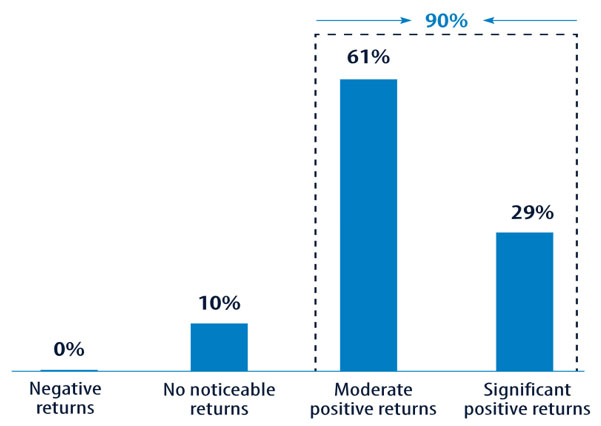
Financial returns for ESG initiatives
Sector-Specific ESG Materiality
ESG materiality depends on a firm’s industry or sector. Labor protections, for example, are more material for industries like textiles, metals and mining as opposed to tech. Similarly, environmental concerns are more material in the energy sector as opposed to manufacturing.
While preparing to analyse future materiality of ESG factors, companies must assess which factors will become material based on their industry/specific. Investors have already begun factoring sector-specific context to assess company risk preparedness. An example is Blackrock, an investment management firm that built a low-carbon transition framework and assigned a transition score to companies using disclosed data, and sector-specific context.
Chart: ESG Issues by Sector Materiality – SASB

Regulatory Landscape and ESG Disclosure
Chart: Indian ESG Reporting Regulations Timeline

A major challenge to ESG performance has been the inability of companies to comply with the differing standards of many different ESG rating and reporting agencies. However, in the last five years, major consolidation efforts have removed this problem. IFRS (of the ISSB standards) and GRI recently announced a partnership to align their standards. Now consolidated, mandatory disclosures are being emphasized by regulatory bodies. SEBI, for example, has solidified BRSR standards as a pre-requisite filing for the top 1,000 listed companies by market cap.
Transparency in ESG reporting is essential for investor confidence and compliance. Companies must stay abreast of evolving regulations to ensure accurate and comprehensive ESG disclosures
Conclusion: Time to Evolve ESG into EESG
As ESG issues evolve from ethical considerations into financially material risks and opportunities, it’s time for a paradigm shift. Companies can no longer afford to treat ESG as a “compliance box”—it must be integrated into core strategy and capital allocation.
The missing link in many ESG conversations is Economic impact—how ESG issues translate into profitability, productivity, and performance. It is time to transition from ESG to EESG, where Economic sustainability is equally emphasized alongside environmental, social, and governance dimensions. This shift will allow companies to make smarter trade-offs, align with stakeholders, and ensure long-term value creation—not just for shareholders, but for society.