Rohan Jain, Senior Consultant at Avalon Consulting, contributed his perspective on ““Bridging the Renewable Gap:” BESS, the backbone for tomorrow’s energy systems” submitted as part of Cordence Worldwide’s “The Insight Initiative,” a global blog and position paper competition for young consultants in the YPN network.
He highlights how Battery Energy Storage Systems (BESS) are emerging as the key enabler for managing renewable intermittency, strengthening grid reliability, and supporting the global shift toward clean energy. He outlines the major BESS integration models co-located, hybrid, and virtual power plants and discusses the barriers to large-scale adoption, including high upfront costs and regulatory gaps. He emphasizes that declining battery prices, viability gap funding, and urgent grid modernization will accelerate BESS deployment, making it central to the future of sustainable and resilient energy systems.
The global energy sector is going through a rapid transition driven by increasing demand, increasing share of renewables and their inherent intermittency posing serious challenge to grid stability and reliability. Battery Energy Storage Systems (BESS) has emerged as a leading enabler during this transition providing the flexibility, responsiveness, and resilience needed to balance fluctuating supply and demand.
Surging energy demand and increasing share of renewables is creating the need for energy storage systems
The global electricity demand has grown by a CAGR of 3% over the last 10 years with 2024 witnessing the highest growth at 4% (+1172TWh) compared to 2023. The growth was witnessed due to multiple reasons such as weather conditions, emerging drivers such as electric vehicles, data centers and heat pumps. In recent years, with increasing energy consumption demand, global regulations to reduce GHG emissions and efforts to lower carbon footprint across geographies is creating a need to invest in renewable sources of energy. According to International Energy Agency (IEA), the global investment in clean energy technology and infrastructure is projected to be two times the investment in fossil fuels. In 2025, out of an estimated investment of $3.3 trillion into the energy sector, up 2% against 2024, around $2,2 trillion will go to renewable and nuclear energy, double the amount going to oil, natural gas and coal.
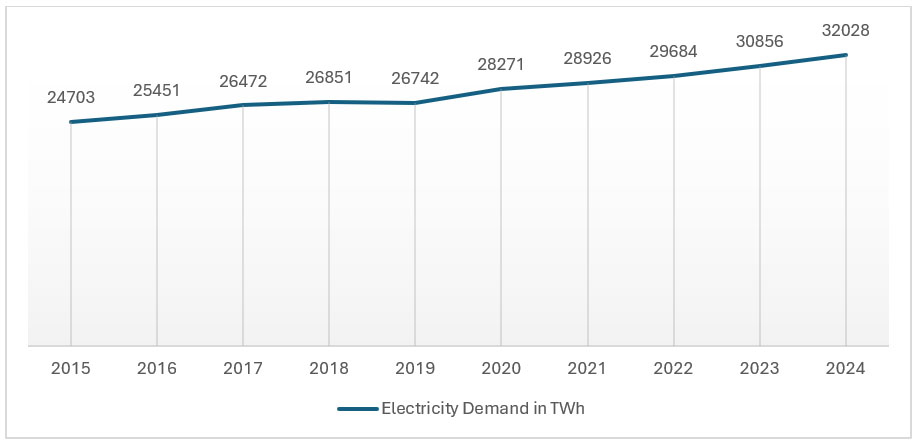
Source: Yearly electricity data, Ember
Energy generation by fossil fuel contributed to 87% of the total energy generation however, as per IEA, the share of renewables in energy consumption is expected to reach 20% by 2030. These developments are propelling the demand for Battery Energy Storage Systems (BESS). BESS are technologies designed to store energy for extended periods, typically over 6-8 hours, to support grid stability and decarbonization. Battery storage is an essential enabler for renewable energy generation, supporting the alternative sources of energy to make a steady contribution to global energy requirements. BESS brings flexibility in deployment from small scale to large scale options and is integral to applications such as peak load balancing, utility optimization and backup power during outages. According to the report published by the IEA, global BESS rose 40GW in 2023, nearly doubling the total increase in capacity compared to 2022. Driven by decreasing battery costs and government support, global investments in battery storage grew by 76% in 2023, to $36 billion and is expected to reach $150 billion by 2030, total battery storage capacity reaching 760GW by 2030 from 86GW in 2023.
Battery Energy Storage Systems (BESS) offer the greatest potential and impact among the Long Duration Energy Storage technologies
Battery Energy Storage Systems (BESS) are crucial for modernizing the grid, reducing dependency on fossil fuel, enhancing grid stability by peak shaving, and addressing demand during periods of energy outage. BESS application is divided into three segments: front-of-the-meter (FTM), which includes utility-scale installations with storage capacity upwards of 10MWh, behind-the-meter (BTM) commercial and industrial installations, typically ranging from 30KWh to 10MWh, and BTM residential installations with storage capacity less than 30KWh. FTM utility-scale installations dominate the market with nearly 80% share. BESS technologies such as aqueous electrolyte flow batteries, metal anode batteries, and hybrid flow batteries offer a Round-Trip Efficiency (RTE) of 40-80% proving to be competitive technology among the other Long Duration Energy Storage (LDES) systems.
Integration models of Renewables and Battery Storage
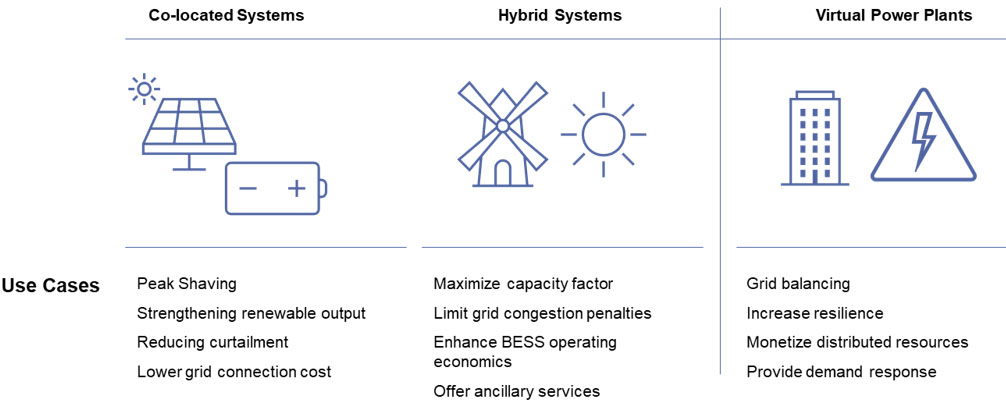
The deployment of Battery Energy Storage Systems is key to effectively utilizing the technology to its full capacity. Globally various modes of deployment is practiced depending on the application for the BESS as under:
- Co-located Systems: The BESS is physically located at the same site as the renewable energy generation asset such as wind, solar, etc. Each such co-located BESS operates independently and has its own interconnection with the grid for distribution of energy across applications
- Hybrid Systems: The hybrid integration of battery storage enables the charging of the battery through a combination of renewable energy sources such as solar or wind which addresses the intermittent nature of renewable energy and is integrated into the central grid for addressing demand during peak hours
- Virtual Power Plants: Renewable energy installations at residential or commercial application utilizes BESS as a standalone power distribution unit coordinated by software and dispatches electricity during intermittent supply of power from the grid
Source: Avalon Consulting Research & Analysis
Cracking the code to global BESS adoption
The sole cost of deploying a battery storage system at a grid-scale installation comes at a very high capex due to high upfront cost for Li-ion batteries which primarily dominate the market. Absence of clear regulations and provisions on ownership of storage assets and unclear revenue streams for the technology has limited the adoption of BESS on a global scale. BESS technology also relies on critical minerals such as lithium, cobalt, and nickel which face price volatility due to dependence on few geographies for supplies of these minerals. Moreover, complexity in integrating BESS to central grid adds to further cost of making the system robust and scalable.
However, the increasing need for energy and intermittent supply of renewable energy through sources such as solar, wind, biomass, etc. necessitates the need to store energy for reducing the load on the central power grid and addressing the depleting fossil fuel. Battery Storage Systems’ high RTE and energy density makes it a more scalable storage solution compared to other Long Duration Energy Storage (LDES) systems, and the adoption is expected to rise owing to the following factors:
- Declining battery capital costs: BESS capital costs are projected to drop by 23% by 2030 due to advances in new battery technologies such as Na-ion and hybrid (li-Na). The Na-ion battery chemistry offers a high energy density in the range of 75 to 200Wh/kg and lower dependence on critical minerals with sodium being the 6th most abundant mineral in the Earth’s crust and is easily available from sea sites, limestone mines, etc.
- Viability Gap Funding (VGF): Countries across the globe are introducing budgetary support for providing financial assistance to battery storage projects. As on 2024, China is leading the BESS industry at an installed capacity of 215.5 GWh which contributes to 65% of the global BESS capacity, USA is trailing China with installed capacity of 82.1 GWh. Developing countries such as India has launched a VGF scheme with an initial outlay of INR 94 billion, including INR 37.6 billion in budgetary support and provide financial assistance of up to 40% of the capital expenditure for these projects. Such VGF scheme supports in deploying overall costs of the BESS
- Grid modernization and decentralization: Globally, the development timeline of modern grid is five to seven times slower than renewable energy installations and as per IEA, a USD 14.3 trillion shortfall in global grid expansion and modernization is expected by 2050. However, with governments realizing the need to modernize and decentralize the grid to accommodate renewable energy and respond to increasing electricity needs would accelerate the modernization efforts, in effect leading to rise in BESS adoption
Battery Storage systems, although are more reliable in terms of energy efficiency, global large-scale deployments are heavily reliant on lowering the capital expenditure through various technological advancements and government financial support.

Rohan Jain
Rohan is a Senior Consultant at Avalon specializing in Strategy and Growth Projects including M&A, Market Entry and Performance Improvement, with 6+ years of experience in Information Technology and Automobile Industries. His previous experience includes Product Development and Market Entry Strategy for one of the largest Indian Automobile Player in the Commercial Vehicles space. He has pursued his MBA in Marketing from Symbiosis, Pune and also holds a Bachelor’s degree in Mechanical Engineering from West Bengal University of Technology
Email: rohan.jain@consultavalon.com