

Parul Gupta and Ridhi Kukreja, Consultants at Avalon Consulting, shared their views on BluSmart’s collapse in the article “BluSmart’s Downfall: A Wake-up Call for Indian Startups.”
They highlighted that despite a strong EV ride-hailing model and rapid growth, governance failures, opaque financial structures, and related-party transactions eroded trust and ultimately led to the startup’s downfall. The case underscores that innovation and scale cannot compensate for weak transparency and financial discipline.
Further, they suggested that startups must embed strong governance, prudent cash-flow management, diversified dependencies, and transparent stakeholder communication from the outset to build sustainable, crisis-resilient businesses.

In the vibrant streets of Delhi-NCR and Bengaluru, BluSmart’s electric vehicles stood for more than just transportation—they represented India’s commitment to sustainability. While Ola and Uber faced challenges with surge pricing and contractor disputes, this EV ride-hailing startup offered a groundbreaking solution: owned fleets, dedicated drivers, zero emissions, and true stability for all the concerned stakeholders.
With 8,000 electric vehicles completing over 30,000 rides daily and ₹400+ crore raised from domestic and international investors, BluSmart looked unstoppable. Unlike traditional cabs/rides giants, the drivers were employed full time, with a stable income and dignity in this economy. For customers, it meant reliable service without surge pricing nightmares and long waiting hours. For investors, it represented the ideal balance of sustainability and scalability.
That future died in 2025, leaving behind a trail of broken promises and a tough lesson about transparency in India’s startup ecosystem.
Weak Financial Foundation and Lack of Trust
Behind BluSmart’s impressive growth numbers lay a dangerous secret that would eventually bring down the entire operation. The fleet that defined the company did not belong to BluSmart, but by a related listed entity Gensol Engineering co-founded by its own promoters. This seemingly clever financial structure allowed BluSmart to scale rapidly without massive capital expenditure, but it also created a web of conflicts that later become its undoing.

BluSmart Financials (in INR Crs.)- As per BluSmart Website and Tracxn
Blusmart’s revenue was ~172 Cr in FY24, grew 142% from FY23 that was 71 cr only. Also, expenses rose by 124% with major components of finance costs and depreciation, despite having most of their fleet as leased from Gensol and other 3rd party companies. The company was heavily leveraged, eventually leading to credit downgrades and default. They even masked their inability to pay by misrepresenting “no-default” letters to rating agencies.
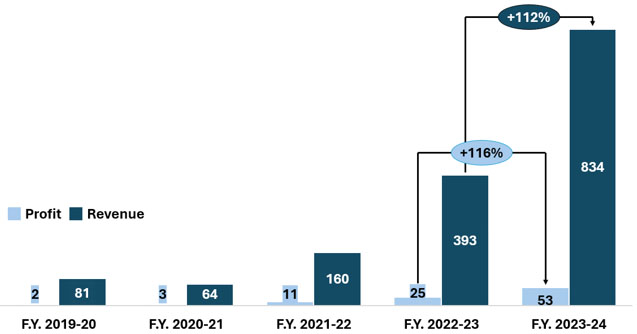
Gensol Engineering Financials (in INR Crs.)- As per Money Control
Not only Blusmart, but Gensol’s revenue in FY24 jumped 112% from FY23 and profits rose by 116% in FY24.
Has Gensol Engineering recognized BluSmart’s operational activity, lease payments, or even profits as its own, and are its reported profits and revenues reflective of actual independently generated business?
Gensol had announced pre-orders for 30,000 EVs in January 2025 and a strategic tie-up with Refex Green Mobility for 2,997 EVs. However, SEBI found that these were based on non-binding MOUs with no pricing or delivery schedules. A surprise inspection by NSE revealed that Gensol’s EV manufacturing plant in Pune was practically non-functional, with minimal power usage and no significant activity.
The story does not end here, over ₹978 crore in loans and public funds, which was raised by Gensol Engineering from 2021 onwards to buy 6400 EVs, flowed through this cozy relationship between the two entities. And only ~4700 vehicles were bought from Go-Auto, diversion of ~₹260 crore was noticed.
The regulator traced the alleged methods of diversion, finding that funds transferred from Gensol to the EV supplier (Go-Auto) were often routed back, either directly to Gensol or through a complex web of transactions involving other related entities (such as Wellray Solar Solutions, Gosolar Ventures, Matrix gas and renewables, Param Renewable Energy, and Capbridge Ventures, linked to the promoters)
Instead of staying within the operating company and building a sustainable infrastructure, the funds were diverted to personal luxuries that would infuriate any investor. A ₹50 crore apartment here, private travel expenses there, even high-end golf equipment of—all funded by money meant for electric vehicles and driver welfare.
When SEBI began investigated this maze of related-party transactions, the operations halted overnight, the promoters were barred from capital markets, and the lenders moved to repossess vehicles. Years of careful brand building vanished in weeks.
BluSmart’s failure became worse, and the company suddenly stopped communicating. A brand built on trust and transparency went completely silent.
Over 10,000 drivers, who had left other jobs for BluSmart, were asked to return their vehicles for audits and then heard nothing. Their weekly payments stopped; calls and messages were ignored.
Customers’ money got stuck in Blu Wallet, refunds being delayed and employees were unaware about their jobs and salaries. The worst part was that no one explained anything, in tough times, clear communication can help, but BluSmart’s silence only made things worse.
Governance Isn’t Optional—It’s Survival Infrastructure
BluSmart’s story proves the severe effect that a fundamental governance failure can have, even when the business model is brilliant and has a genuine market demand. The company’s impressive operational metrics meant nothing when trust in the leadership is broken. From day one, startups must establish independent board oversight, maintain strict separation between personal and corporate finances, and implement robust internal controls.
It’s the foundation that enables sustainable growth and investor confidence and is not just a bureaucratic overhead. The startups thriving in the next decade will be those that build governance into their DNA, not those that treat it as a compliance checkbox to be addressed when they expand
The New Rules of Startup Viability
In today’s rapidly changing startup environment, the journey of BluSmart highlights some of the crucial factors for success in capital-intensive, operationally demanding industries. This case ideals that aggressive growth & market dominance are no longer enough; there should be a focus on financial management, adaptable business models, and robust funding strategies to manage economic shifts. BluSmart prioritized quality (owing the EV fleet, hiring drivers, and developing proprietary charging stations), which helped in building customer loyalty, but it also led to a capital-heavy model and for this reason, the startup faced a hard time when their funding dried up and market dynamics shifted.
This shows that modern startups should balance innovation with cost efficiency, prioritize scalable partnerships over full ownership, diversify revenue sources, and optimize asset use. It is also important to ensure financial viability along with prudent cash flow management and sustainable profitability to withstand market volatility. A sharp focus on unit economics and adapting flexibly to funding conditions is essential for startups to survive in these uncertain times.
Smart startups diversify their critical suppliers, partners, and operational dependencies from the start, unlike the case of BluSmart having fatal dependence on the related company, causing a catastrophic failure when one started facing regulatory & operational challenges.
It might cost more initially and add complexity, but it prevents the total operational collapse that leaves thousands of stakeholders stranded.
Proactive compliance across all business functions is about maintaining operational continuity and stakeholder trust and not just about avoiding penalties. The startups that embrace compliance as competitive advantage, not cost, will outlast those that don’t.
In the time of crisis, BluSmart’s complete lack of transparent communication with employees, drivers, and customers destroyed whatever trust remained. Crisis communication plans, stakeholder protection protocols, and transparent engagement models are the essential infrastructure for any startup touching real people’s livelihoods and not just the luxuries for later-stage companies.
Wake up call for Startups
BluSmart’s journey from promising startup to cautionary tale talks about a fundamental truth that is reshaping India’s entrepreneurial landscape: innovation without integrity is ultimately unsustainable. The startups that build their innovation on bedrock of ethical leadership, financial discipline, scalable models, strong unit economics, and operational resilience will thrive in the long term.
Every crisis BluSmart faced was preventable through better governance, transparent financial management, checking the viability of the model, and stakeholder-first thinking. Startups that understand these lessons and follow them from the beginning will succeed more than their peers.
For millions of users who rely on digital platforms for daily needs, the BluSmart collapse represents more than a business story, it reflects a breach of faith that reshapes how they view the entire startup ecosystem. Every time someone books a ride through another app now, there’s a lingering question: which platform will be next to break the trust that took years to build and seconds to destroy?

Parul Gupta
Parul Gupta is a Consultant at Avalon Consulting, with a focus on Consulting, Process Optimization, and New Product Development. She holds an MBA from the Xavier Institute of Management, Bhubaneswar, and brings experience across a range of sectors including Chemicals, and IT & Analytics Consulting. Her cross-industry background fuels her strong interest in applying technology-driven solutions to business challenges. Beyond her professional life, Parul enjoys playing football and basketball and has a deep appreciation for music

Ridhi Kukreja
Ridhi Kukreja is a Consultant at Avalon Consulting, specializing in Consulting, Advisory, and Risk Management. She holds an MBA in Strategy and Marketing from IIFT and provides strategic insights to clients, particularly in ESG and sustainability compliance. Passionate about environmental and social issues, she actively engages in initiatives within these domains. In addition to her professional pursuits, Ridhi is also a dancer and an occasional writer.